It is a situation that plays out on UK development sites more often than the industry admits. A gas membrane is installed by a specialist contractor who then produces their own sign-off document confirming the work meets the required standard. The developer takes that document, submits it to the local planning authority to discharge the gas protection condition, and then waits. The condition is rejected. The local authority will not accept it. And the concrete slab that covers the membrane has already been poured.
This is the consequence of relying on an installer to verify their own work. It is not permitted under UK guidance, it does not satisfy planning authorities, and it leaves the developer exposed to liability, delays, and potentially significant cost.
This guide explains exactly why independent ground gas membrane verification is required, what CIRIA C735 and BS8485 actually say about it, what real installation failures look like on site, and how to make sure your project is protected from the beginning.
The Core Problem: Installers Cannot Independently Verify Their Own Work
CIRIA C735 is the UK’s definitive guidance document on the testing and verification of protection systems for buildings against hazardous ground gases. Section 3.2.2 of that guidance states without ambiguity that an independent third party must be used for verification to avoid conflicts of interest.
The word independent carries specific meaning here. It means the verifier cannot be the membrane installation contractor. It cannot be a company within the same group of businesses. It cannot be a colleague, a subsidiary, or a sister company of the installer. The verifier must have no financial or commercial relationship with the installation that would compromise their objectivity.
The reason this rule exists is straightforward. An installer who verifies their own work has a direct interest in that work being declared compliant. If they find a problem, fixing it costs them time and money. An independent verifier has no such interest. Their only obligation is to report accurately on what was installed and whether it meets the required standard.
| What CIRIA actually saysCIRIA C735 (2014) states: ‘A risk-based approach to verification is required and an independent third party should be used for verification to avoid conflicts of interest. Integrity testing should be used as well as visual inspection to demonstrate a gas-tight seal is present across the membrane.’ This is the governing guidance document referenced in BS8485:2015+A1:2019, which is the British Standard for all gas protection membrane design in new buildings. |
Despite this being clear and published guidance since 2014, the quality of gas protection verification across the UK remains variable. When CL:AIRE launched the Gas Protection Verification Accreditation Scheme (GPVS) in January 2021, its founding purpose was to address exactly this problem. In the RICS Built Environment Journal, the scheme’s founders described the standard of verification for gas protection membranes as frustratingly variable and acknowledged that quality issues with installation and verification were an ongoing concern in the brownfield sector.
What Actually Goes Wrong When Installers Self-Certify
The risk is not theoretical. There are well-documented categories of installation failure that independent verification consistently catches, but that installer self-certification routinely misses or does not report.
Inadequate membrane laps
A gas protection membrane must overlap at joints by a minimum distance and those joints must be bonded correctly with the specified adhesive or heat weld. If the overlap is insufficient or the bond has not fully adhered, gas can migrate through the joint. This is one of the most common defects found during independent integrity testing and one of the least likely to be reported by the installer, since it reflects directly on their workmanship.
Unsealed or poorly sealed service penetrations
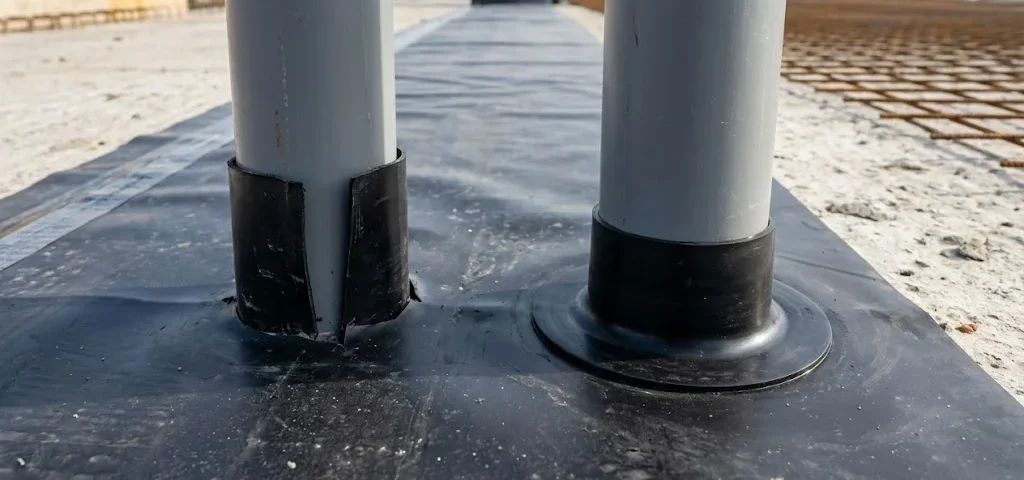
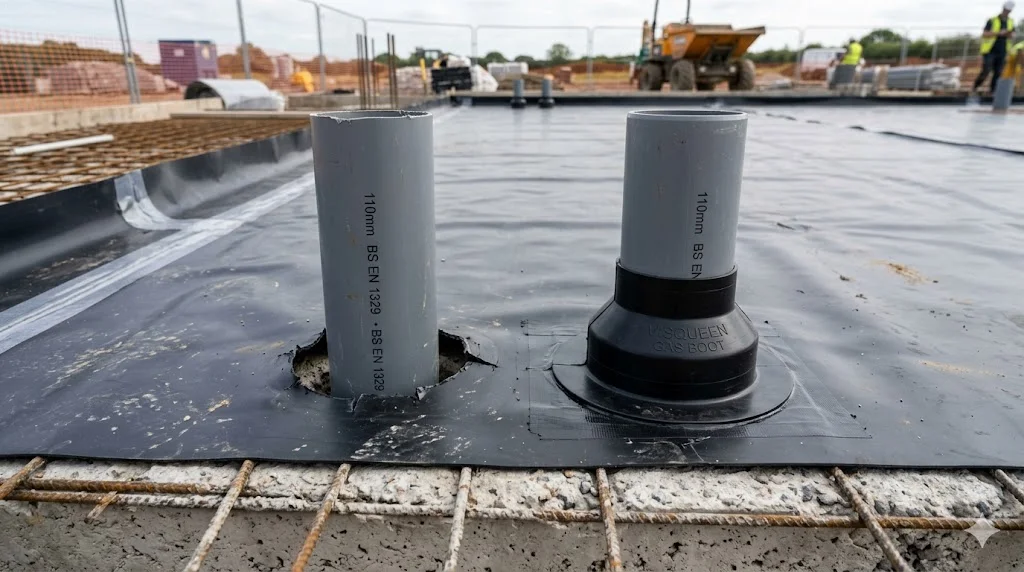
Every pipe, duct, or cable that passes through a gas membrane creates a potential pathway for gas migration. The membrane must be cut and sealed around each penetration using a proprietary boot, collar, or sealant system that is compatible with the membrane specification. On busy construction sites where multiple trades are working simultaneously, these details are frequently missed, rushed, or carried out incorrectly by follow-on contractors who may not understand what the membrane is there to do.
Membrane damage from follow-on trades
One of the most significant risks to gas membrane integrity is not the installation itself but what happens after it. Reinforced concrete crews, plumbers, electricians, and groundworkers all work over or around membranes before the slab is poured. Punctures, tears, and displaced sections are common. An installer who inspects their own work immediately after laying it cannot account for damage caused by follow-on contractors in the days or weeks that follow. An independent verifier, carrying out inspections at the correct construction milestones, can.
Wrong product installed
Gas protection membranes must be selected to meet the requirements of BS8485:2015+A1:2019 for the site’s specific Characteristic Situation classification. On some sites, the membrane specified by the environmental consultant is substituted by the installer for an alternative product, sometimes because of supply issues, sometimes for cost reasons. If that substituted product does not meet the required specification, the protection system is non-compliant regardless of how well it was installed. An independent verifier checks the product specification at the pre-installation stage. An installer verifying their own work has no incentive to flag that the product they sourced may not be appropriate.
What CIRIA C735 Says About Unqualified Installers
There is an additional dimension to this that developers working on tighter budgets should understand carefully. CIRIA C735 contains specific guidance on what happens when the membrane installer is not a qualified gas-membrane specialist.
The guidance is clear: if the installation is carried out by unqualified operatives, such as general groundworkers rather than trained gas membrane installers, then the level and detail of verification must be increased significantly. In those circumstances, CIRIA C735 indicates that 100% of the installation must be independently evaluated, not just the spot checks and milestone inspections that would apply to a qualified installer.
This matters for two reasons. First, it demonstrates that CIRIA C735 treats installer qualification and independent verification as connected but separate requirements. Qualification reduces risk at the installation stage. Independent verification manages residual risk after installation. Neither replaces the other. Second, it means that choosing a cheaper, unqualified installer to save money at the installation stage can actually increase the cost of verification significantly, often to the point where the saving is completely wiped out.
| The hidden cost of cheap installationDevelopers often focus on the cost of verification when selecting a gas membrane installer. The reality is that using an unqualified installer can trigger a requirement for 100% independent inspection of every plot, every penetration, and every joint under CIRIA C735. The cost of that level of verification can far exceed the savings made on the installation itself, while also adding significant time to the programme. |
How the GPVS Scheme Changes What Developers Should Expect
CL:AIRE launched the Gas Protection Verification Accreditation Scheme (GPVS) in January 2021. It was developed by industry leaders in gas protection verification in direct response to the variable quality of verification work across the UK. The scheme is supported by the Environment Agency, Natural Resources Wales, NIEA, and SEPA, and is referenced in the government’s Land Contamination Risk Management (LCRM) guidance as the recommended route for gas membrane verification and reporting.
The GPVS operates two accreditation levels. The Technician in Gas Protection Verification (TGPV) covers field technicians who carry out site inspections. The Specialist in Gas Protection Verification (SGPV) covers those qualified to manage the full verification process and sign off verification reports. Both levels require applicants to demonstrate core competencies through an application and interview process, and both require renewal every four years through continuing professional development.
For developers, the GPVS provides a practical way to identify genuinely qualified and independent verifiers. A verification report produced by an accredited SGPV carries a CL:AIRE Quality Mark declaration with a unique reference number, which planning authorities can trace back to the registered individual. This gives local authority officers far greater confidence in the report than an unaccredited submission.
| What Gets Checked | Installer Self-Sign-Off | Independent CIRIA C735 Verification |
|---|---|---|
| Product compliance with BS8485 | Rarely documented formally | Checked at pre-installation stage |
| Membrane lap widths and bonding | Assumed correct by installer | Physically measured and photographed |
| Service penetration sealing | May be noted but not tested | Checked at each milestone inspection |
| Damage from follow-on trades | Not inspected after the fact | Multi-stage inspections capture this |
| Integrity testing (air lance or EHD) | Almost never carried out | Specified in the Verification Plan |
| Formal report for planning authority | No standardised format | Structured report with CL:AIRE Quality Mark |
The Consequences When Verification Is Done by the Wrong Person
When a developer submits a verification report produced by the installer, or by a company with a commercial connection to the installer, they face a range predictable outcomes, none of them positive.
The local planning authority rejects the submission. The gas protection planning condition remains undischarged. The building cannot be legally occupied. At this point, the developer has two problems: they need a new, independent verification report, and the membrane is now under a concrete slab. Depending on when the rejection comes and what the local authority requires, this can mean additional inspection visits, integrity testing, and in the worst cases, opening up sections of the slab to check the membrane beneath it.
The liability issue is equally serious. A developer who has relied on an installer’s self-certification and later faces a gas-related incident involving occupants of the building has very little legal protection. They cannot point to an independent assessment that confirmed the system was correctly installed. They cannot demonstrate due diligence. The entire liability for the protection failure sits with them.
For house builders working under NHBC warranties, there is an additional layer of risk. NHBC guidance on hazardous ground gas, which aligns closely with BS8485 and CIRIA C735, requires that gas protection measures are installed and verified correctly. A failure to provide compliant independent verification can result in warranty cover being withheld, which in turn creates serious issues at the point of sale when solicitors and mortgage lenders review the property documentation.
When to Appoint Your Independent Verifier and What Happens Next
The single most important thing a developer can do is appoint an independent verifier before installation begins, not after. This is not just good practice. CIRIA C735 requires the verifier to produce a Verification Implementation Plan prior to any installation works commencing. That plan sets out the inspection milestones, the integrity testing requirements, and the documentation that will be needed for the final verification report.
If a verifier is brought in after the membrane is already laid, they are being asked to certify something they did not witness. They cannot confirm the condition of the membrane before follow-on trades worked over it. They cannot confirm that the correct product was installed. They cannot confirm that laps were bonded correctly at the time of installation. They are, at best, able to make a partial assessment of what remains visible. Local authorities understand this, and they are increasingly likely to question the validity of a late-appointed verification.
For a full explanation of how the verification process works from the pre-installation stage through to planning condition discharge, read our guide on what ground gas verification involves and when it is required.
If you have been asked to discharge a planning condition relating to gas protection and are not sure what is needed, our step-by-step guide on how to discharge a ground gas planning condition walks through the full process.
Contractors who want to understand exactly what an independent verifier will be checking at each stage of a gas membrane installation can find a full breakdown in our guide to gas membrane installation inspections.
| Work with a genuinely independent verifierGround Gas Verification provides fully independent gas membrane verification across the UK. We have no commercial connection to any membrane manufacturer or installation contractor. Every verification is carried out in accordance with CIRIA C735 and BS8485:2015+A1:2019. Contact us at groundgasverification.co.uk before your installation begins. |
Frequently Asked Questions
| 1. Can the company that installs the membrane verify it as well?No. CIRIA C735 requires the verifier to be completely independent of the installer and any material supplier involved in the project. This is not a recommendation but a requirement that planning authorities expect to see met. A verification report signed off by the installing contractor, or by any company with a commercial link to them, will not satisfy most local planning authorities. |
| 2. Why do planning authorities reject installer self-certification?Because it creates a clear conflict of interest. An installer who signs off their own work has a financial reason for that work to be declared compliant. Planning authorities need objective evidence that the gas protection system was installed correctly, and that evidence can only come from someone with no stake in the outcome of the installation. That is what an independent verifier provides. |
| 3. What is the CL:AIRE GPVS and do I need a verifier who is accredited on it?The Gas Protection Verification Accreditation Scheme (GPVS) was launched by CL:AIRE in January 2021 to raise the standard of gas membrane verification across the UK. It has two levels: Technician in Gas Protection Verification (TGPV) for site inspectors, and Specialist in Gas Protection Verification (SGPV) for those who prepare and sign off verification reports. The Environment Agency and other regulators support the scheme, and it is referenced in the government’s LCRM guidance. While accreditation is not yet mandatory, it is increasingly expected by local authorities as a mark of competence. |
| 4. What happens if the membrane has already been installed before I appoint a verifier?This is a common problem and it significantly limits what a verifier can do. Once the membrane is laid and follow-on trades have worked over it, the verifier cannot confirm the condition of the membrane as it was installed. If the concrete slab has already been poured, independent verification in the proper sense is not possible. In some cases, local authorities will require opening-up works to expose the membrane. The only way to avoid this situation is to appoint a verifier before installation begins. |
| 5. Does using an unqualified installer affect the verification requirements?Yes, significantly. CIRIA C735 states that if the membrane is installed by unqualified operatives, the scope and intensity of independent verification must be increased to compensate. In practice this can mean 100% inspection of the full installation rather than the milestone-based approach used for qualified installers. This often costs more in verification fees than the developer saved by using a cheaper unqualified contractor. |
| 6. What are the most common installation defects that independent verification catches?The most frequently identified defects are insufficient membrane lap widths, inadequate bonding at joints, incomplete sealing around pipe and service penetrations, membrane damage caused by follow-on trades after installation, and the use of a product that does not match the specified material or does not meet BS8485 requirements. All of these are invisible once the slab is poured. |
| 7. Will a verification report from an independent verifier always satisfy the local planning authority?A well-structured, CIRIA C735-compliant verification report from a genuinely independent and competent verifier will satisfy the gas protection planning condition in the vast majority of cases. Problems arise when the report is incomplete, when the verifier is not demonstrably independent, when inspections were not carried out at the right stages, or when integrity testing required by the CS classification was not undertaken. This is why the quality and credentials of your chosen verifier matter. |
| 8. Does independent verification cover radon protection systems as well?Yes. Where a radon protection membrane has been installed as a planning condition or to comply with Part C of the Building Regulations, the same independence requirement applies. The verifier must confirm that the radon membrane was correctly installed in accordance with the specification, using an appropriate product, with all penetrations properly sealed. |
The Bottom Line
The gas protection membrane installed beneath your building is designed to protect every person who will ever live or work there from the hazardous gases in the ground below. Once the concrete slab is poured, that membrane is invisible and inaccessible. The only way to know with confidence that it was installed correctly is through independent verification carried out by someone with no connection to the installation and no interest in its outcome.
CIRIA C735 and BS8485 are clear on this point. Local planning authorities increasingly enforce it. The CL:AIRE GPVS now provides a formal route to identify accredited verifiers. And the commercial, legal, and safety consequences of getting it wrong are substantial.
Appoint your independent verifier before installation begins, not after. That single decision protects your planning approval, your programme, your warranty cover, and ultimately the safety of the building you are delivering.