Your gas membrane is down. The concrete pour is scheduled for tomorrow. Then the verification engineer arrives , and finds problems.
This happens on UK development sites more often than it should. Not because of unusual bad luck, but because the same handful of installation mistakes come up again and again. Most of them are quick to avoid. All of them are expensive to fix after the slab has gone down.
This guide covers the specific mistakes that cause gas membrane installations to fail independent verification in the UK, why each one matters under BS 8485:2015+A1:2019 and CIRIA C735:2014, and what you need to do differently to pass first time.
What Verification Is Actually Checking
Ground gas verification is an independent, third-party inspection that confirms your gas protection system has been installed in line with the approved design and current UK standards. It is not optional on sites classified at CS2 or above under BS 8485, or Amber 2 and above under NHBC. Without a valid verification report, the Local Planning Authority cannot discharge your gas-related planning condition. No discharge means no occupation.
CIRIA C735 is direct about this: verification is as important as design and installation. That puts the quality of the installation on equal footing with the engineer’s design.
The verifier is checking two things. First, that what has actually been installed matches the approved specification. Second, that the membrane and all its components form a genuinely gas-tight barrier , not just one that looks fine visually. Integrity testing through air lancing, pick and probe, dielectric testing, or tracer gas is what confirms the second part. Visual inspection alone is never enough.
For a full explanation of what goes into the report and how it satisfies your planning condition, read our guide on what a ground gas verification report is and how it discharges your planning conditions.
Mistake 1: The Wrong Membrane for the Site’s Gas Risk Level
Specifying or substituting a membrane that does not match the site’s Gas Characteristic Situation (GCS) is one of the most fundamental errors , and one of the most common.
BS 8485:2015+A1:2019 classifies sites from CS1 (negligible risk) up to CS6 (high risk). The membrane must meet the methane and carbon dioxide gas transmission thresholds for the site’s classification, and it must hold a BBA or BDA certification proving it does. A standard DPM does not qualify. A low-permeability membrane rated for Amber 1 or CS1 does not qualify on a CS3 site.
NHBC’s NF94 guidance, updated in 2025, has added another dimension. It now recommends non-foil membranes for Type A locations because aluminium foil layers can corrode in aggressive ground conditions over time. Verifiers are increasingly querying foil-based products at these locations and asking for data sheet confirmation. If you have switched from the specified product , even to something with comparable performance , you need written agreement from the design consultant before installation. Without it, the verifier cannot confirm compliance.
| ⚠️ Red flagThe product installed does not match the design specification. Even a direct equivalent requires written design sign-off before it can replace the specified membrane on site. |
Mistake 2: Lap Joints That Are Not Actually Sealed
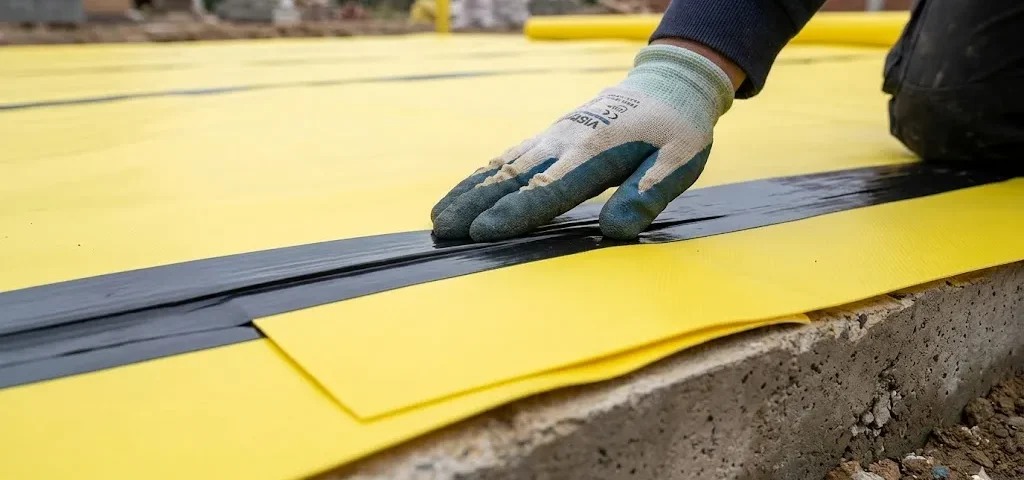
Lap joints are the first thing a verifier checks and the most frequently failed detail. A joint that looks fine on the surface can have no real adhesion underneath , and air lancing will find it immediately.
The minimum overlap width is set by the manufacturer’s installation guidance, typically 150mm to 300mm depending on the product and jointing method. Tape must be the correct gas-rated product for the membrane, applied to a clean dry surface, at a temperature above 5°C. Applying tape to a cold, damp, or dusty surface produces a joint that appears stuck but provides no gas-tight seal.
Heat-welded seams must fuse fully across the entire lap width without gaps or burn-through. A manual pick probe run along an underwelded seam will expose the failure in seconds. On multi-plot sites, CIRIA C735 requires air lancing of all joints and penetrations to ASTM D4437 as part of the inspection regime. Sites that rely only on visual checks are taking a gamble with their programme.
Mistake 3: Pipe and Service Penetrations Left Unsealed or Bodged
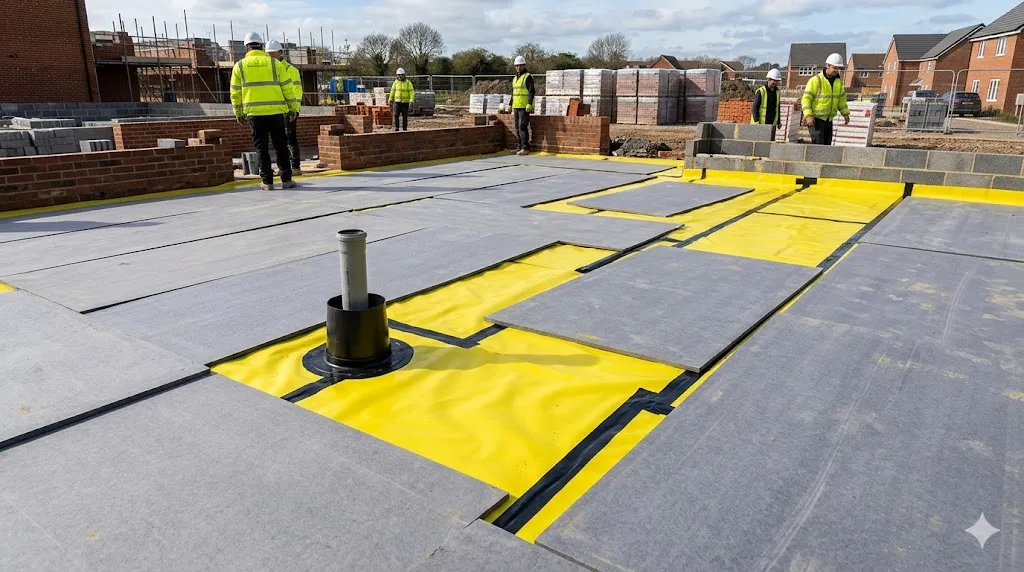
Every pipe, cable, or duct that passes through the membrane is a potential gas pathway. On a typical housing plot there are several. Each one needs a purpose-made gas-resistant top hat unit or sleeve, correctly lapped onto the main membrane and sealed with the manufacturer-specified tape or mastic.
What verifiers routinely find instead: standard building tape used around the pipe, foam filler pushed into the gap, or no collar at all. None of these provide a gas-tight seal. Dielectric testing can detect a hole as small as 1mm² in the membrane surface, and a failed penetration seal will register every time.
The principle is continuity. The membrane must form an unbroken boot around every penetration, lapping back onto the main sheet with the correct overlap. Where services enter through a wall or ground beam, the gas DPC must connect to the floor membrane to maintain the barrier across the junction.
Penetration Details: What the Verifier Is Looking For
| Penetration type | Required detail | Most common failure |
|---|---|---|
| Service pipe (horizontal) | Gas-rated top hat unit, min. 150mm lap onto main membrane, sealed with approved tape | Standard DPM tape used; lap too short or absent |
| Cable / conduit | Pre-formed collar or sleeve sealed with compatible mastic or tape | No collar used; gap filled with foam only |
| Gas DPC / wall junction | Gas DPC lapped continuously into floor membrane, sealed at upstand | Junction not made; floor and wall systems disconnected |
| Drainage outlet | Manufacturer-supplied gas-resistant collar bonded to membrane | Membrane cut without collar; plumber’s tape only |
All penetration details must match the approved design. Substitutions require written consultant sign-off.
Mistake 4: Follow-On Trades Damaging the Membrane
This is the mistake that catches sites out even when the membrane installer did everything correctly. The membrane goes down before the reinforcement cage or the concrete slab. Every trade that comes on site afterwards , rebar fixers, plumbers, electricians , is walking on it, kneeling on it, and dragging equipment across it.
CIRIA C735 is explicit: follow-on trades must be told what the membrane is and why it matters. In practice that means toolbox talks, site signage, and a protection layer placed over the membrane immediately after installation , geotextile, protection boards, or sand blinding where the sequence allows.
Reinforcement chairs pushed through the membrane, foot traffic on taped joints, rebar bars dropped on top of unsealed laps , these are routine finds during verification. Some punctures are invisible to the naked eye. That is exactly why dielectric and air lancing testing exists.
If the membrane cannot be inspected before the pour, the verifier cannot sign it off. Their report cannot discharge the planning condition. Protecting the membrane from the moment it is laid is not a detail. It is what makes the whole system work.
Mistake 5: Calling the Verifier After the Slab Is Down
It sounds like an avoidable mistake. It happens constantly. A verifier called only after the concrete has been poured cannot inspect the membrane. They cannot confirm lap integrity, penetration details, or sump placement. They cannot issue a report that satisfies the LPA.
CIRIA C735 recommends agreeing a verification plan before construction begins. This sets inspection frequency, testing methods, installer qualification requirements, and documentation to be gathered. On multi-plot sites with NVQ Level 2-qualified installers, not every plot requires a verifier visit , but a minimum frequency is set by the site’s risk classification. Where the installation team has no formal qualification, 100 per cent independent inspection is the CIRIA C735 baseline.
The practical rule: get the verifier involved at the pre-construction stage, not after the pour. Their pre-agreed plan means inspections happen at the right point in the programme, documentation is collected as work proceeds, and the final report is straightforward to produce.
Understanding exactly how the verification report works and what the LPA needs to see is covered in our guide to what a ground gas verification report is and how it discharges planning conditions.
Mistake 6: Incomplete Documentation
A verification report is only as strong as the evidence it contains. Local Planning Authorities and NHBC will scrutinise the document, and missing elements are grounds for rejection and re-submission.
Under CIRIA C735, the report must include: the design reference and approved drawings, BBA or BDA data sheets for every product used, dated photographs of the installation at each critical stage, integrity test results, weather conditions during site visits, and confirmation of the verifier’s independence and qualifications. If the product installed was substituted without written approval, its data sheet and any after-the-fact photographs will not satisfy the LPA. The documentation needs to reflect what was actually agreed and what was actually built, in that order.
| ⚠️ Documentation tipPhotographs taken after the membrane has been partially covered, or data sheets for a product that was not the one specified, are common reasons for LPA rejection. Build the documentation file in real time as installation progresses , not retrospectively. |
The Short Version
Wrong membrane product, unsealed laps, bodged penetrations, damage from follow-on trades, a pour that went ahead before the verifier arrived, documentation assembled too late. These are not rare or unusual problems. They are the same issues that delay planning discharge on development sites across the UK every week.
The good news: every one of them is preventable. Get the membrane specification confirmed before ordering. Agree the verification plan before breaking ground. Protect the membrane from follow-on trades the moment it is laid. Call the verifier at the right stage.
If you are unsure whether your installation is ready for sign-off, the time to find out is before the concrete goes down.
Frequently Asked Questions
Why does gas membrane verification matter for planning permission?
Gas membrane verification is required by the Local Planning Authority before the ground gas planning condition can be discharged. Without an independent verification report confirming the membrane has been correctly installed, no occupation of the development is permitted. This requirement applies to sites classified at CS2 or above under BS 8485:2015+A1:2019, or Amber 2 and above under NHBC.
What is the most common reason a gas membrane fails verification?
The most common failure is inadequately sealed lap joints. Tape applied to a cold, damp, or dusty surface produces a joint that looks sealed but has no real gas-tight adhesion. Air lancing to ASTM D4437 detects these failures even when visual inspection shows nothing wrong.
Can the membrane installer carry out verification themselves?
No. CIRIA C735:2014 requires verification to be carried out by an independent third party to avoid conflicts of interest. The verifier must have no commercial connection to the installation contractor. They should hold the CL:AIRE GPVS accreditation or NVQ Level 4 in Verification of Ground Gas Protection Systems and be a member of the British Verification Council.
Is a standard DPM acceptable as a gas membrane?
No. A damp-proof membrane and a gas-resistant membrane are different products with different performance requirements. Gas membranes must meet specific methane and carbon dioxide transmission rate thresholds defined in BS 8485:2015+A1:2019 and must hold BBA or BDA certification. Using a standard DPM on a site classified above CS1 will fail verification and will not discharge the planning condition.
When in the construction programme should the verifier be appointed?
The verifier should be appointed before construction begins, not after installation. CIRIA C735 recommends agreeing a verification plan at the pre-construction stage, setting out inspection frequency, testing methods, and documentation requirements. Verifiers appointed only after the slab is down cannot inspect the membrane and cannot issue a compliant report.
What integrity tests are used during gas membrane verification?
The main integrity tests used in the UK are: air lancing to ASTM D4437 (pressurised air along joints), pick and probe (manual testing of seams and penetrations), dielectric testing (detects holes as small as 1mm²), tracer gas testing, and smoke testing. The methods used are agreed in the verification plan based on the site’s risk classification.
How does follow-on trade damage get picked up during verification?
Damage caused by follow-on trades , punctures from rebar, tears at lap joints, crushed top hat units , is identified during visual inspection and confirmed through integrity testing. Dielectric testing can detect pinhole-sized damage invisible to the naked eye. If damage is found after the slab has been poured, remediation typically requires breaking out finished works.
What happens if gas membrane verification fails?
If verification identifies defects, the report cannot be issued in a form that discharges the planning condition. Defects must be remediated, and the affected area re-inspected and re-tested before a compliant report can be issued. Where concrete has already been poured over a failed area, remediation involves significant breaking-out works.
Does the membrane product need to match the design specification exactly?
Yes. The verifier confirms that the installed product matches the approved design specification. Any substitution , even a product with equivalent performance , requires written agreement from the design consultant before installation. Without that documented approval, the verifier cannot confirm compliance and the report cannot be issued.
What qualifications should a gas membrane installer have?
Installers should hold NVQ Level 2 in ground gas membrane installation, available through CITB and CL:AIRE. Where the installation team holds no formal qualification, CIRIA C735 recommends that 100 per cent of the installation is independently inspected. Installer qualification records should be included in the verification documentation pack.