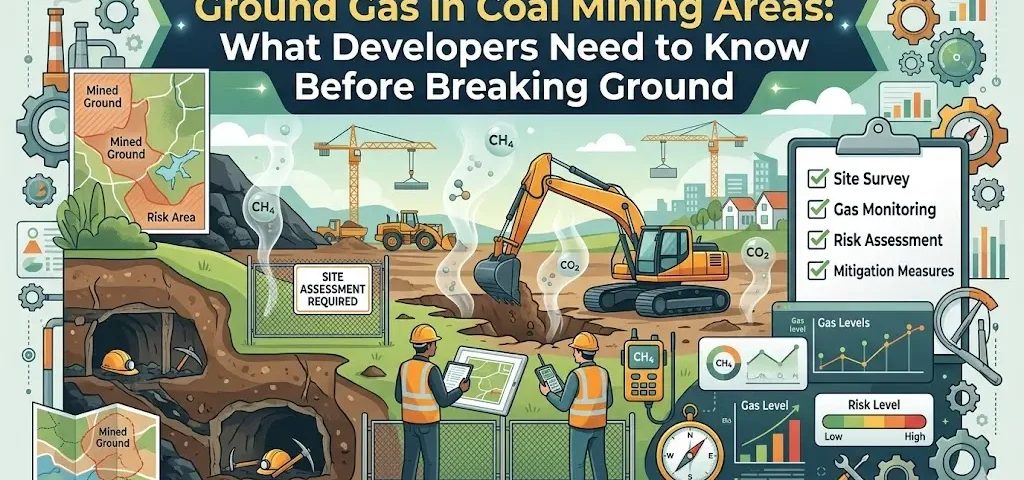
The UK’s coalfields cover approximately 6,000 square kilometres across Yorkshire, Nottinghamshire, Derbyshire, Lancashire, the Midlands, South Wales, Fife, and Ayrshire. That is six million square metres of land with a mining legacy underneath. For developers building on any site within these areas, ground gas is not a possibility. It is a certainty that must be assessed, designed for, and independently verified before occupation.
The Coal Authority, renamed the Mining Remediation Authority in 2024, manages this legacy. They operate a risk-based approach split into Development High Risk Areas where shallow coal mining activity directly affects new construction, and Development Low Risk Areas where workings are deeper but still require assessment. If your site falls in either zone, you have formal obligations before planning permission can progress, and further obligations before the building can be occupied.
Why Coal Mining Areas Generate Ground Gas
Coal seams and associated strata naturally contain methane, which was trapped underground for millions of years. When mining occurs, whether historical deep mining or more recent surface operations, methane is released. Abandoned mine workings act as reservoirs and migration pathways for both methane and carbon dioxide generated by organic decomposition within the mine voids. The gas does not stay where it was generated. It migrates through fractured rock, old shafts, drift entries, and along geological faulting, sometimes travelling significant distances from the original source.
Carbon dioxide in coal mining areas is equally significant. Unlike methane which is primarily a combustion and explosion risk, CO2 is a heavier-than-air asphyxiant that accumulates in basements, service trenches, and poorly ventilated ground floors. CIRIA C758D, the Abandoned Mine Workings Manual published in 2019, identifies both gases as requiring specific assessment in coalfield areas.
| The 15% and 85% split that mattersThe Coal Authority divides the coalfield into Development High Risk Areas covering 15% of the total coalfield where coal workings are shallow and likely to affect development directly, and Development Low Risk Areas covering 85% where workings are deeper but still require gas risk assessment. Developers must check which zone their site sits in before submitting a planning application, as the High Risk Area triggers mandatory Coal Mining Risk Assessment and statutory Coal Authority consultation. |
The Coal Authority’s Development Risk Areas and What They Mean for Planning
Every planning application on land within the Coal Mining Reporting Area must be checked against the Coal Authority’s online interactive map. The map shows whether the site falls in the Development High Risk Area, the Development Low Risk Area, or outside the coalfield entirely.
For sites in the Development High Risk Area, a Coal Mining Risk Assessment is mandatory before the planning application can be validated. The Coal Authority is a statutory consultee and must be consulted on the application. The risk assessment must address ground stability, shallow mine entries, mine gas emissions, and past surface hazards. The ground gas element of this assessment follows the same CIRIA C665 and BS8576 framework used on all contaminated sites, but with specific consideration for mine gas migration pathways including shafts, adits, and geological discontinuities.
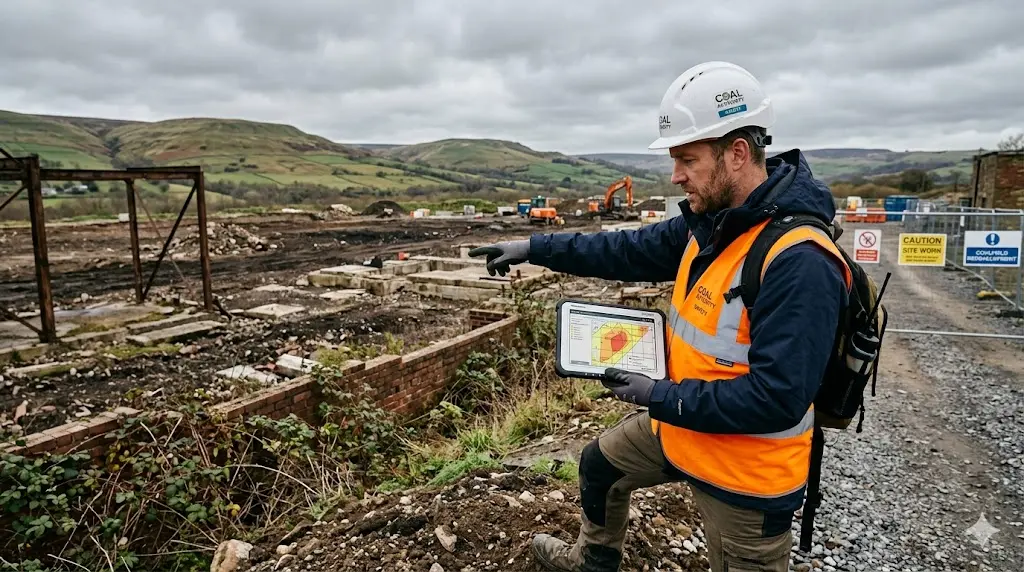
For sites in the Development Low Risk Area, formal Coal Mining Risk Assessment is not always required, but a Phase 1 desk study must still consider mine gas as part of the preliminary risk assessment. If the Phase 1 identifies mine gas sources within 250 metres of the site or identifies geological features that could act as migration pathways, a Phase 2 ground gas monitoring programme is triggered.
What Ground Gas Monitoring in Coalfield Areas Must Cover
Gas monitoring in coal mining areas follows BS8576:2013 but with mine-specific considerations. Standard monitoring standpipes installed into boreholes capture methane, carbon dioxide, oxygen, and atmospheric pressure at regular intervals over a minimum monitoring period of several weeks. The difference in coalfield areas is that gas flow rates can be highly variable, peak concentrations may not follow atmospheric pressure correlations in the same way landfill gas does, and lateral migration from distant sources means gas can appear in locations where local geology would not predict it.
CL:AIRE published Good Practice for Risk Assessment for Coal Mine Gas Emissions in 2021 specifically to address these characteristics. The guidance identifies that mine gas emissions can be episodic, can vary significantly over short timescales, and that single-visit or short-duration monitoring campaigns may miss elevated gas episodes entirely. For sites close to known mine entries or within 50 metres of recorded shallow workings, extended monitoring with continuous data logging may be required to capture the full range of gas behaviour.
Methane concentration thresholds in coal mining areas
BS8485:2015+A1:2019 classifies sites using the Characteristic Situation model from CS1 to CS4 based on peak methane concentration, peak CO2 concentration, and gas flow rate. Methane above 1.0% by volume is the threshold at which CS2 classification is triggered, requiring full gas protection measures including membrane and verification. In coal mining areas, methane concentrations above 5% have been recorded in some monitoring programmes, pushing sites into CS3 or CS4 classifications requiring active ventilation or sump systems.
Carbon dioxide behaviour in coalfield developments
CO2 is frequently the dominant gas in abandoned coal mine emissions, particularly in areas where biological activity within the mine voids is generating CO2 through organic decomposition. Peak CO2 concentrations above 5% by volume trigger CS2 classification. Scottish Government guidance published in 2024 on CO2 mine gas specifically highlights that CO2 accumulation in basements and subfloor voids is a significant risk on coalfield sites and that developers must account for this in protection system design.
The Four Developer Obligations on Coalfield Sites
1. Commission a Coal Authority online report or mining search before land purchase
The Coal Authority offers paid reports providing site-specific mining data. For residential transactions this is the CON29M coal mining report. For developers, the more comprehensive Coal Mining Risk Assessment data pack includes historical mine plans, recorded shallow workings, mine entries, and known hazards. This should be commissioned at the earliest stage, ideally before land acquisition, to identify whether the site falls in the High Risk Area and what gas mitigation will be required.
2. Produce a Coal Mining Risk Assessment if in a Development High Risk Area
If the site is in the High Risk Area, a formal Coal Mining Risk Assessment must be submitted with the planning application. The assessment covers ground stability, mine gas, past surface hazards, and shallow mine entries. The ground gas section must follow LCRM Stage 1 risk assessment principles with mine-specific pathway analysis. The Coal Authority reviews this assessment as a statutory consultee and can object to the application if the assessment is inadequate or if proposed mitigation is insufficient.
3. Carry out Phase 2 ground gas monitoring where Phase 1 identifies mine gas sources
If Phase 1 identifies mine workings, mine entries, or mine gas emissions within 250 metres, or if the site geology suggests mine gas migration pathways exist, a Phase 2 monitoring programme is required. The monitoring must run for a minimum period capturing seasonal and barometric pressure variation, with a minimum of three monitoring rounds. CL:AIRE 2021 guidance recommends extended monitoring on sites with known shallow workings or proximity to active or capped shafts.
4. Appoint an independent verifier before gas membrane installation begins
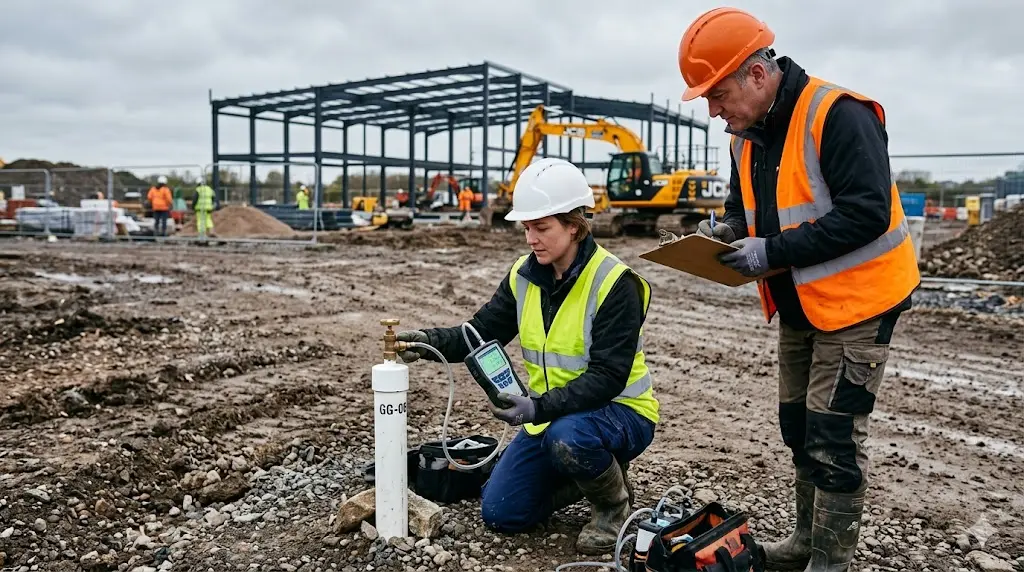
For sites classified CS2 or above, BS8485:2015+A1:2019 requires independent verification of the installed gas protection system to CIRIA C735. The verifier must be independent of the installer, must produce a Verification Implementation Plan before installation, and must carry out inspections at each construction milestone. The verification report is submitted to discharge the gas protection planning condition. Some Coal Authority consultation responses specifically reference the need for verification in their planning comments, making it a condition of approval.
Why Coalfield Ground Gas Cannot Be Self-Certified
The independence requirement in CIRIA C735 applies equally to coalfield sites as it does to landfill or brownfield sites. The verifier cannot be the membrane installer, cannot be commercially connected to the installer, and cannot be the developer’s groundwork contractor. This principle exists because mine gas protection systems often involve more complex details than standard ground gas installations, including connections to active ventilation systems, multiple service penetrations from mine water pumping infrastructure where applicable, and membrane continuity across sites with variable ground conditions.
Local authorities in coalfield regions including Yorkshire, Nottinghamshire, Derbyshire, Fife, and South Wales have seen an increase in rejected verification submissions where the independence requirement was not met. The contaminated land officers in these authorities work closely with the Coal Authority and are trained to check verifier credentials. Submissions from installers self-certifying their own work or from companies within the developer’s own group structure are regularly rejected.
How Ground Gas Verification Supports Coalfield Developers
Coalfield development is a significant proportion of brownfield housing delivery across the Midlands, Yorkshire, South Wales, and Scotland. The Coal Authority’s updated guidance and CL:AIRE’s 2021 mine gas risk assessment framework have made the requirements clearer, but compliance depends on early identification of gas risks, adequate monitoring, correct protection system design, and credible independent verification.
Ground Gas Verification provides fully independent verification services across all UK coalfield regions. We understand mine gas migration behaviour, work with Coal Authority data, and produce CIRIA C735-compliant reports that satisfy both the planning authority’s contaminated land officer and the Coal Authority where they have been consulted as a statutory body. We appoint before installation begins, carry out inspections at every required milestone, and deliver verification reports that discharge gas protection conditions without requiring resubmission.
Frequently Asked Questions
How do I know if my site is in a coal mining area?
Check the Coal Authority interactive map at gov.uk/guidance/coal-mining-ground-stability-and-liability. Enter the site postcode to see if it falls within the Coal Mining Reporting Area and whether it is in the Development High Risk Area or Low Risk Area. For detailed mining information, commission a Coal Authority CON29M report or Coal Mining Risk Assessment data pack.
Do I need a Coal Mining Risk Assessment for every site in a coalfield?
Only if the site is in the Development High Risk Area, which covers 15% of the coalfield. Sites in the Development Low Risk Area (85% of the coalfield) require mine gas consideration in the Phase 1 desk study and Phase 2 monitoring where risks are identified, but do not automatically require a formal Coal Mining Risk Assessment for planning purposes.
What is the difference between mine gas and landfill gas?
Both produce methane and carbon dioxide, but mine gas can have different migration characteristics. Mine workings act as gas reservoirs with complex pathways including shafts, drifts, and faulting that allow lateral migration over significant distances. Gas flow rates in coal mining areas can be more episodic than landfill emissions and may not correlate as predictably with barometric pressure. The protection systems are similar, but the risk assessment must account for mine-specific pathways.
Does radon affect coalfield sites?
Some coalfield areas, particularly in Derbyshire and parts of Scotland, also fall within radon-affected areas. Where this occurs, the gas protection system must provide protection against methane, CO2, and radon simultaneously. The design must justify that the selected membrane performs against all three gases, and the verification must confirm this.