
Contaminated land is the single most common reason brownfield planning conditions stall at the pre-commencement stage. Developers who underestimate the assessment requirements, appoint the wrong consultant, or fail to follow the correct framework end up with planning permissions they cannot implement, pre-commencement conditions they cannot discharge, and programme delays that compound through every subsequent stage.
The regulatory framework that governs contaminated land assessment in the UK, Land Contamination Risk Management (LCRM), was published by the Environment Agency in 2020 and updated most recently in June 2025. It replaced the previous CLR11 guidance and now applies across England, Wales, Scotland, and Northern Ireland. Every planning authority in the country references it, every competent person assessment must follow it, and every developer building on any site with a contamination risk needs to understand what it requires.
This guide explains what contaminated land assessment involves at each stage, how local planning authorities apply it through planning conditions, and where ground gas fits into the wider contamination picture.
What Contaminated Land Assessment Is and Why Planning Requires It
A contaminated land assessment is a structured investigation of a development site to identify whether any contamination present in the ground poses an unacceptable risk to future occupiers, the environment, or controlled waters. It is not a single document. It is a staged process that moves from desktop review through to site investigation, risk quantification, remediation where needed, and verification that remediation was effective.
Under the National Planning Policy Framework, paragraph 180, planning authorities must ensure that development on land affected by contamination is appropriate to that land. Developers must demonstrate that the land is or can be made suitable for the proposed use. This means that for any site with a suspected contamination risk, contaminated land assessment work will form part of the planning application requirements, either as information submitted with the application or as a series of conditions attached to the consent.
The contamination risks assessed can include heavy metals and hydrocarbons from industrial history, asbestos from demolished structures, pesticide residues from agricultural use, leachate from filled ground, and ground gases from organic decomposition or mining activity. Ground gas, including methane and carbon dioxide from former landfills, VOCs from fuel and solvent contamination, radon from natural geology, and mine gases from coalfields, is one category within the wider contamination assessment but one that carries specific additional requirements, including independent membrane verification, that sit outside the general contamination framework.
The LCRM Framework: Three Stages Every Developer Must Understand
LCRM organises the contaminated land assessment process into three sequential stages. Developers do not always need to complete all three, but they must always begin at Stage 1 and progress through the stages in order based on what each stage finds.
| LCRM Stage | What Happens | When Further Action Is Required |
|---|---|---|
| Stage 1: Risk Assessment | Phase 1 desk study and site walkover builds the Conceptual Site Model. If risks are identified, Phase 2 intrusive investigation and Generic Quantitative Risk Assessment (GQRA) follow. Detailed Quantitative Risk Assessment (DQRA) where GQRA cannot confirm acceptable risk. | If Phase 1 identifies plausible pollutant linkages, Phase 2 is triggered. If GQRA shows unacceptable risk, DQRA is required. |
| Stage 2: Options Appraisal | Identifies and evaluates remediation options for any unacceptable risks identified in Stage 1. Produces a Remediation Strategy with a timetable of works. | Required whenever Stage 1 confirms unacceptable risk that cannot be managed through design or restriction alone. |
| Stage 3: Remediation and Verification | Implements the approved Remediation Strategy. Verification confirms that remediation achieved its objectives. Produces a Verification Report for submission to the planning authority. | Required whenever a Remediation Strategy was produced and works have been carried out. |
Most brownfield developments proceed through all three stages. A greenfield site with no credible contamination risk may complete Stage 1 with a negative finding and require nothing further. A site on former industrial land will typically require Stages 1, 2, and 3, with planning conditions attached at each stage requiring submission and approval before works can progress.
Phase 1: The Desk Study and Site Walkover
Phase 1 is the gateway into the contaminated land framework. It is a non-intrusive assessment that combines a desktop review of historical records with a physical inspection of the site. Under LCRM, a site walkover is now mandatory for Phase 1, a requirement that was not always clearly enforced under the previous CLR11 guidance.
The desk study draws on historical Ordnance Survey maps, fire insurance plans, aerial photographs, Environment Agency regulatory databases, BGS borehole records, and the site’s planning history to reconstruct how the land has been used over the past century or more. The walkover adds direct observation of current site conditions, including any visible signs of contamination, made ground, drainage patterns, and adjoining land uses.
The output is a Conceptual Site Model (CSM). The CSM maps the source-pathway-receptor relationships for the site: what potential contaminants are present or could have been deposited, by what routes they could migrate to people or the environment, and who or what could be harmed. It is the CSM that local planning authority officers evaluate when they decide whether a Phase 2 intrusive investigation is required.
| Phase 1 timeline and cost: what to expectA Phase 1 desk study and walkover for a standard brownfield site typically takes between one and two weeks to complete. Timescales extend for larger or more complex sites or where historical records are fragmentary. A Phase 1 report is normally required as part of the planning application submission or as a pre-commencement condition. The cost of a Phase 1 ranges from approximately £1,500 to £5,000 depending on site size and complexity. Omitting it or commissioning a substandard report is one of the most common reasons planning conditions remain outstanding at the point when a developer wants to break ground. |
Phase 2: Intrusive Site Investigation and Risk Assessment
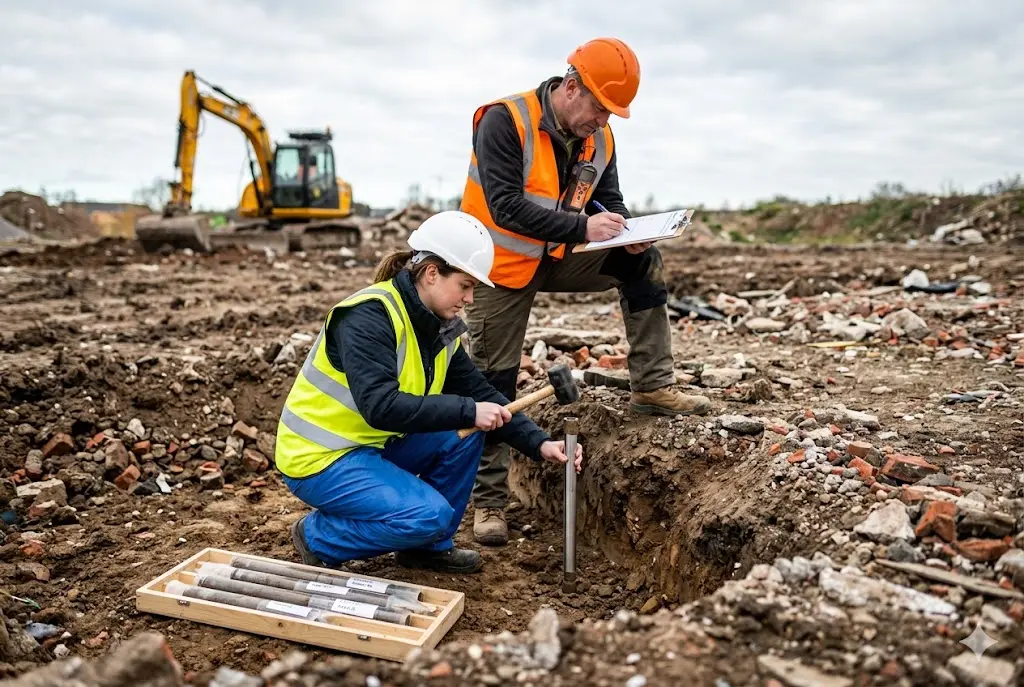
When Phase 1 identifies plausible pollutant linkages, Phase 2 moves from desk to field. Intrusive investigation involves installing boreholes and trial pits to collect soil, groundwater, and where relevant ground gas samples. These are analysed in an accredited laboratory and the results are used to produce a Generic Quantitative Risk Assessment (GQRA) that evaluates whether the contaminant concentrations found pose an unacceptable risk to the people and receptors identified in the Phase 1 CSM.
Ground gas monitoring, where triggered by Phase 1 findings, is carried out as part of Phase 2. A minimum of three monitoring rounds spaced over several weeks is required to capture gas behaviour under varying atmospheric conditions. The monitoring programme covers methane, carbon dioxide, oxygen, and atmospheric pressure. The results are used to classify the site using the Characteristic Situation methodology of BS8576 and BS8485, which determines what level of gas protection is required and triggers the independent verification obligation for CS2 and above.
Phase 2 fieldwork typically requires one to two days for standard sites, but laboratory analysis, data interpretation, and report preparation take a further four to six weeks. Developers who have not programmed this lead time into their pre-commencement sequence regularly find that Phase 2 becomes a critical path constraint that delays first fix and groundworks.
How Contaminated Land Planning Conditions Are Structured
Planning authorities attach contaminated land conditions in two main forms. Pre-commencement conditions require the completion and approval of assessment work before any development begins. Pre-occupation conditions require the completion of remediation and verification work before the building can be occupied or brought into use.
A typical multi-stage condition structure for a brownfield residential site in England runs as follows. Before commencement, a Phase 1 desk study must be submitted and approved. If Phase 1 identifies risks, a Phase 2 investigation must be submitted and approved before commencement. If Phase 2 confirms unacceptable risk, a Remediation Strategy must be submitted and approved before commencement. Then, before occupation, a Verification Report confirming that all remediation works were carried out in accordance with the approved strategy must be submitted and approved.
Derby City Council’s Environmental Protection Team illustrates this directly in its published consultation responses. Their standard condition wording requires Phase 1 to be submitted before commencement, Phase 2 where Phase 1 identifies contamination, a Remediation Strategy before development proceeds, and a completion report before occupation. This structure is broadly consistent across local authorities in England and is what the LCRM guidance is designed to support.
| Why getting the sequence right matters commerciallyPre-commencement conditions are conditions precedent. Development cannot legally start until they are discharged. A developer who breaks ground before a required Phase 1 report has been approved by the local planning authority is technically in breach of their planning permission, which can have serious consequences for the validity of the consent and any future sale or transfer of the property. The Phase 1 must be commissioned early enough that it is complete and approved before the programme requires works to begin. |
Where Ground Gas Fits Into the Contaminated Land Assessment
Ground gas is one category of contamination risk within the wider contaminated land framework, but it has specific additional requirements that go beyond the standard LCRM process. Where Phase 1 identifies a potential for ground gas from landfill, mining, peat, or industrial sources, Phase 2 must include a dedicated gas monitoring programme following BS8576:2013.
If monitoring classifies the site as CS2 or above under BS8485, the planning condition will include a requirement for an independently verified gas protection system before occupation. This verification, carried out in accordance with CIRIA C735 by an independent specialist, is separate from the general LCRM Stage 3 verification process for soil and groundwater remediation. It follows a different framework, has its own Verification Implementation Plan requirement, and produces a Gas Protection Measures Verification Report specifically for submission to discharge the gas-related planning condition.
Many developers and their project teams fail to appreciate that gas membrane verification is a distinct requirement from the general contamination verification report. Contamination consultants who can complete LCRM Stage 3 soil and groundwater verification are not automatically qualified to carry out CIRIA C735 gas membrane verification. The two require different competencies, different site attendance programmes, and different outputs.
For development sites where ground gas is identified as part of the contaminated land assessment, Ground Gas Verification provides the independent CIRIA C735 verification service that planning authorities require.
How We Support Developers Through the Contaminated Land and Gas Verification Process
Contaminated land assessment is the foundation on which every brownfield development is built. Getting the framework right from Phase 1 through to Stage 3 verification determines whether planning conditions discharge on time, whether occupation sign-off comes through without last-minute delays, and whether the developer can demonstrate the due diligence that protects them from future liability.
Ground gas is the contamination risk category where developers most commonly discover, too late, that the assessment and verification requirements are more demanding than they expected. Phase 1 flags a historic landfill within 250 metres. Phase 2 monitoring classifies the site as CS2. A gas protection membrane is added to the design. And then the independent CIRIA C735 verification requirement arrives, with its own pre-installation plan, its own inspection milestones, its own integrity testing, and its own separate report for planning submission.
At Ground Gas Verification, we sit at that specific stage of the contaminated land process. We provide the independent verification that CIRIA C735 requires for CS2 and above sites, working in parallel with the wider contamination assessment team and producing the Gas Protection Measures Verification Report in the structure that planning authorities require to discharge the gas protection condition. We are entirely independent of membrane manufacturers and installation contractors, and we work across all site types from straightforward residential brownfield plots to complex multi-use former industrial sites.
Frequently Asked Questions
Does every planning application need a contaminated land assessment?
Not every application, but any site with a history of industrial use, filled ground, landfill, mining activity, agricultural chemicals, petrol storage, or any other potential contamination source will require at minimum a Phase 1 desk study. Even greenfield sites can attract Phase 1 requirements if neighbouring land uses create potential migration risks. Local authorities increasingly require Phase 1 as standard for all brownfield applications.
What is the Conceptual Site Model and why do planning authorities care about it?
The Conceptual Site Model (CSM) maps the source, pathway, and receptor relationships for contamination at a specific site. It is the central tool for demonstrating that contamination risks have been properly identified and understood. Planning authority contaminated land officers evaluate the quality of the CSM when deciding whether Phase 2 investigation is required and whether submitted risk assessments are robust enough to discharge conditions. A poorly constructed CSM is one of the most common reasons Phase 1 reports are rejected.
What is the difference between a GQRA and a DQRA?
A Generic Quantitative Risk Assessment (GQRA) uses standardised screening criteria and conservative generic assumptions to evaluate contamination risks. If a GQRA can show that risks are acceptable using these conservative assumptions, no further assessment is needed. If the GQRA flags unacceptable risk using generic criteria, a Detailed Quantitative Risk Assessment (DQRA) is required. A DQRA uses site-specific exposure parameters and more sophisticated modelling to provide a more realistic assessment of actual risk.
How long does a full contaminated land assessment take?
Phase 1 typically takes one to two weeks. If Phase 2 is required, fieldwork takes one to two days but laboratory analysis, interpretation, and reporting add four to six weeks. If remediation is required, the timescale depends entirely on the nature and scale of the works, ranging from a few weeks for targeted soil removal to many months for complex ground gas or groundwater management schemes. Developers should programme contamination assessment at the earliest possible pre-application stage to avoid it becoming a critical path constraint.
Who counts as a competent person for contaminated land assessment?
Under LCRM, reports must be written or peer reviewed by a competent person with relevant knowledge, skills, and experience. The Specialist in Land Condition (SiLC) qualification is the recognised professional standard for contaminated land assessment competency in the UK. Some local authorities specify SiLC qualification explicitly in their guidance. For gas membrane verification specifically, the GPVS SGPV accreditation through CL:AIRE is the recognised competency standard.
Can remediation and gas protection be verified in the same report?
They require separate reports. LCRM Stage 3 produces a Verification Report confirming that soil or groundwater remediation met its objectives. Gas membrane verification under CIRIA C735 produces a Gas Protection Measures Verification Report confirming that the installed gas protection system was correctly installed and tested. The two documents are submitted to discharge different planning conditions and are reviewed by different officers within the local authority, typically the contaminated land officer for LCRM Stage 3 and the environmental health or planning officer for gas verification.