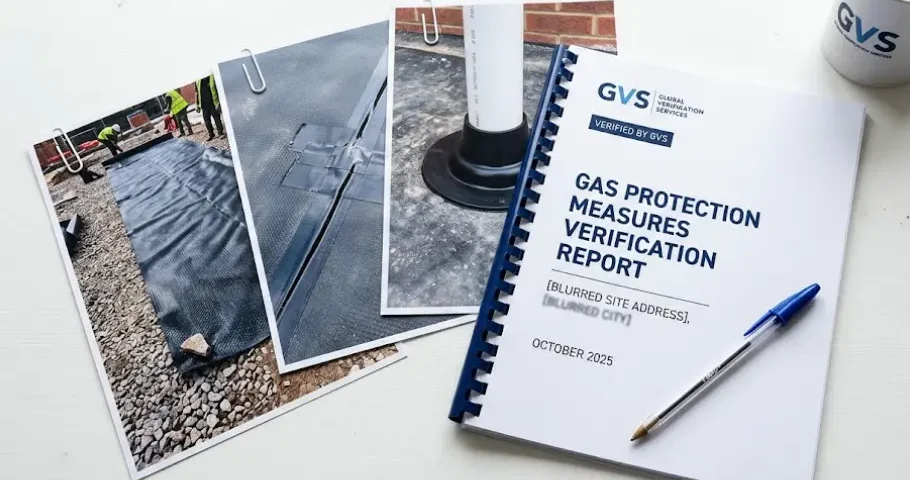
A Ground Gas Verification Report is the formal document produced by an independent verifier confirming that the gas protection system installed beneath your building was correctly designed, installed to the approved specification, and complies with BS8485:2015+A1:2019 and CIRIA C735. Without it, your planning condition cannot be discharged, building control cannot sign off the project, and the building cannot legally be occupied.
The report itself is not optional. It is not a nice-to-have piece of paperwork. For any site classified as Characteristic Situation 2 or above, it is the compliance document that stands between you and planning approval. Yet many developers still do not understand what the report must contain, what the local planning authority checks when reviewing it, or why late-appointed verifiers cannot produce it correctly.
This guide explains what the report is, what must be in it, how the local authority assesses it, and what happens when submissions are rejected.
What a Ground Gas Verification Report Is and Why It Exists
A Ground Gas Verification Report, properly titled a Gas Protection Measures Verification Report, is the output document of the CIRIA C735 verification process. CIRIA C735 is the UK guidance that governs how gas protection systems are verified, and BS8485:2015+A1:2019 is the British Standard that mandates verification as a condition of claiming compliance points for the gas barrier element of a protection scheme.
The report exists to prove three things. First, that the gas protection system installed matches the approved design specification. Second, that the installation was inspected at the correct construction milestones by a qualified, independent verifier. Third, that integrity testing was carried out where required and that any defects identified during installation were corrected before the slab was poured.
Without the report, the local planning authority has no documented assurance that the gas protection system is fit for purpose. They cannot discharge the condition based on assurances from the installer, the developer, or the main contractor, because none of those parties are independent. The verifier’s independence is what makes their report admissible as evidence of compliance.
What Must Be in the Report Under CIRIA C735
CIRIA C735 sets out what a compliant verification report must include. Local planning authorities, contaminated land officers, and environmental health officers check for these elements when reviewing a submission. Any of them being missing is grounds for rejection.
1. Project and Planning Context
The report must open with the planning application reference number, the specific condition number being discharged, the site address, the Characteristic Situation classification, and the date the verification was completed. This section ties the verification directly to the planning consent and confirms what level of protection was required.
2. The Approved Design Specification
The report must include or reference the approved gas protection design scheme. This confirms what was supposed to be installed, including membrane specification, lap requirements, penetration detailing, and ventilation or sump arrangements. The local authority approved this design at the pre-commencement stage and the verification report confirms compliance with it.
3. The Verification Implementation Plan
CIRIA C735 requires the Verification Implementation Plan to be produced before installation begins. The report must include this plan or reference its approval by the local authority. The plan sets the inspection milestones, integrity testing methods, and documentation framework that the rest of the report follows.
4. Inspection Records From Every Site Visit
This is where most reports fail. Appendix A of CIRIA C735 provides a standard proforma for recording each inspection visit. The verifier must document every attended inspection using this proforma or an equivalent structured format covering date, weather conditions, what construction stage was inspected, what was checked, and whether any non-conformances were identified. Multi-plot residential developments require inspection records for every plot or a justified sampling strategy agreed in advance with the local authority.
5. Photographic Evidence at Every Milestone
The photographic record is not incidental. It is the documented evidence that inspections actually took place and that the membrane was in an acceptable condition at each stage. Photographs must show membrane laying, lap joint details, service penetrations, wall-floor junctions, and the final pre-pour condition. Photographs must be clearly labelled with the date, plot number where applicable, and what element they are showing.
6. Integrity Test Results
Where integrity testing was required in the Verification Implementation Plan, the report must include the test results. For air lance testing, this means confirmation that testing was carried out along all joints and penetrations, the equipment used, the pressure applied, and the outcome. For EHD testing, the same detail applies. If defects were found, the report must record what they were, where they were located, how they were remedied, and that retesting confirmed the repair.
7. Non-Conformance Records and Remediation
No installation is perfect. If the verifier identified problems during inspection, the report must record what was found, what correction was specified, and confirmation that the correction was carried out and reinspected. A report that shows zero non-conformances is sometimes a red flag to an experienced reviewer, because it suggests either an exceptionally rare perfect installation or an insufficiently thorough verification.
8. Formal Compliance Statement
The report must close with a formal compliance statement confirming that, in the independent verifier’s professional opinion, the installed gas protection system meets the requirements of BS8485:2015+A1:2019 and has been verified in accordance with CIRIA C735. This statement must be signed and dated by the verifier. Some accredited verifiers include their GPVS registration number and CL:AIRE Quality Mark reference, which gives the local authority a direct audit trail to the verifier’s credentials.
| What local planning authorities are checkingWhen the report lands on the contaminated land officer’s desk, they check: Was the Verification Implementation Plan approved before installation began? Is the verifier demonstrably independent of the installer? Are inspection records complete for every plot or justified sampling? Are photographs clear, labelled, and comprehensive? Are integrity test results included where required? Does the compliance statement reference BS8485 and CIRIA C735 explicitly? A submission that fails any of these checks will be returned for further work or rejected. |
How the Report Discharges the Planning Condition
The gas protection planning condition is typically phrased as a pre-occupation condition, meaning it must be discharged before the building can be legally occupied or brought into use. The wording varies by local authority, but the structure is consistent.
Once the verification report is produced, the developer or their agent submits it to the local planning authority via the Planning Portal or directly to the relevant department. The submission includes the verification report, any appendices such as product data sheets or test certificates, and a covering letter identifying which condition number is being discharged.
The contaminated land officer or environmental health officer reviews the submission against the requirements of the condition, CIRIA C735, and BS8485. If the report is complete and demonstrates compliance, the officer issues a formal decision notice discharging the condition. This is typically a short letter stating that Condition [number] of planning permission [reference] has been discharged, dated and signed by the officer.
Once the condition is discharged, that element of planning compliance is complete. Building control can sign off the building. Occupation can proceed. The developer can progress sales if it is a residential project, or handover if it is commercial. Without the discharge, none of those steps are legally possible.
What Causes Verification Reports to Be Rejected
Based on feedback from planning authority officers published in AGS guidance and YALPAG guidance for Yorkshire and Lincolnshire planning authorities, the most common reasons verification reports are rejected are:
- No Verification Implementation Plan produced before installation began, or the plan produced retrospectively after the slab was poured.
- The verifier is not demonstrably independent, typically because they are the installing company or a subsidiary.
- Inspection records are incomplete, with critical milestones such as pre-pour or penetration inspections missing.
- Photographic evidence is absent, poorly labelled, or does not cover all required elements.
- Integrity testing was required by the CS classification but was not carried out or not documented.
- The compliance statement does not reference BS8485:2015+A1:2019 and CIRIA C735 explicitly.
- The report was produced by unqualified personnel with no demonstrable training or accreditation in gas membrane verification.
Rejection means a further submission is required, which incurs another £116 planning fee, additional verifier time, and in some cases additional site work if the initial verification was insufficient. Where the slab has been poured and the report reveals that inspections were not carried out at the correct milestones, some local authorities require opening-up works, which can be very costly.

How We Deliver Verification Reports That Discharge Conditions First Time
A verification report is only as robust as the verification process that produced it. A verifier appointed after the slab is poured cannot produce a CIRIA C735-compliant report because they did not witness the installation at the required milestones. An installer verifying their own work produces a document that will be rejected on independence grounds. And a report without complete photographic evidence, integrity test results, or inspection records will not satisfy a thorough local authority review.
At Ground Gas Verification, we produce reports that planning authorities accept because we carry out the verification process correctly from the outset. We appoint before installation begins, produce the Verification Implementation Plan, attend site at every required CIRIA C735 milestone, photograph every critical detail, carry out air lance and EHD testing where the plan requires it, document every non-conformance and its resolution, and produce the final report in the structured format that contaminated land officers expect to see.
Frequently Asked Questions
Who produces the Ground Gas Verification Report?
The independent verifier produces the report. They must be completely independent of the membrane installer, material supplier, and developer. Accreditation through the CL:AIRE GPVS scheme at SGPV level is the recognised route for demonstrating competence. An installer cannot produce the report for their own installation work.
When should the report be produced?
The report is produced after all installation work is complete, all inspections have been carried out, and all non-conformances have been resolved. The verifier collates all inspection records, photographs, and test results into the final report. The report cannot be produced before installation is complete, which is why appointing the verifier before installation begins is critical.
Can I submit the report before the building is finished?
Yes. The gas protection verification report is typically submitted as soon as it is complete, even if other construction work is ongoing. This allows the gas protection planning condition to be discharged independently of other pre-occupation conditions such as landscaping or drainage. Early submission reduces programme risk by giving the local authority more time to review.
What if the local authority rejects the report?
The authority issues a rejection notice explaining what is missing or inadequate. The developer must address the issues, which may require additional site visits, further testing, or in the worst case opening-up works to inspect what is now beneath the slab. A revised report is then submitted with a further £116 fee. Programme delays from rejection can be significant.
Does every plot need a separate verification report on a multi-plot development?
Not necessarily. A single report can cover multiple plots if the Verification Implementation Plan justified a sampling approach and the local authority agreed to it in advance. However, many authorities require plot-by-plot verification, particularly for CS2 and above. The default expectation in most regions is individual plot verification unless an alternative is agreed upfront.