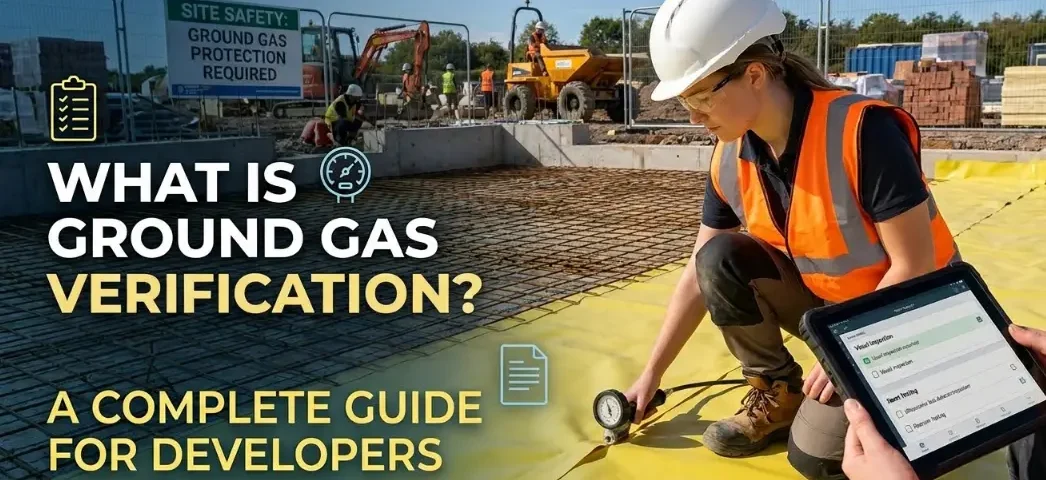
If you are developing on brownfield land, a former landfill, a former gasworks, or any site flagged for hazardous ground gas in a Phase 1 desk study, ground gas verification is not optional. It is a formal regulatory requirement that stands between your project getting planning sign-off and your project stalling at the final hurdle.
And yet, it remains one of the most misunderstood requirements in UK construction. Developers frequently confuse it with the gas risk assessment, the design stage, or the membrane installation itself. They are four completely different things, and getting them confused costs time and money.
This guide explains exactly what ground gas verification is, why it is legally required, what the process involves, and when your project needs it. Whether you are a developer, main contractor, project manager, or environmental consultant working on a site with a potential gas risk, this is the guide to start with.
What Is Ground Gas and Why Does It Matter on UK Development Sites?
Ground gas is any gas produced naturally or through the decomposition of organic material in the ground that can migrate into buildings and create a risk to the people inside. The most common ground gases found on UK development sites are:
- Methane (CH4), which is explosive and flammable at concentrations between 5% and 15% in air.
- Carbon dioxide (CO2), which is asphyxiating at elevated concentrations and displaces oxygen in enclosed spaces.
- Radon, a naturally occurring radioactive gas linked to lung cancer through long-term exposure.
- Volatile organic compounds (VOCs), found on sites with a history of industrial or petrochemical use.
Ground gas is a particular concern on brownfield land, which is now the central focus of UK housing delivery. According to the CPRE State of Brownfield 2025 report, England currently has registered brownfield land capable of delivering at least 1.41 million homes. With the government targeting 300,000 new homes per year and a legislative push toward brownfield-first development, the number of sites requiring ground gas management is rising sharply.
Gas generated by former landfills, buried industrial waste, coal seams, and naturally occurring peat deposits can migrate through soil and enter buildings through floor slabs, service penetrations, or cracks in construction elements. It then accumulates in confined spaces. The risk is invisible until something goes wrong.
What Is Ground Gas Verification?
Ground gas verification, also referred to as gas membrane verification or gas protection measures verification, is the independent third-party inspection and testing process that confirms a gas protection system has been correctly designed, specified, and installed in line with the relevant British Standards and industry guidance.
It is fundamentally different from the stages that come before it:
- The ground gas risk assessment identifies whether a site is at risk and classifies the risk level.
- The gas protection design specifies what membranes, ventilation, or other measures are needed.
- The gas membrane installation is the physical work carried out by a specialist contractor on site.
- Ground gas verification is the independent check that everything installed actually matches the design and meets the required standard.
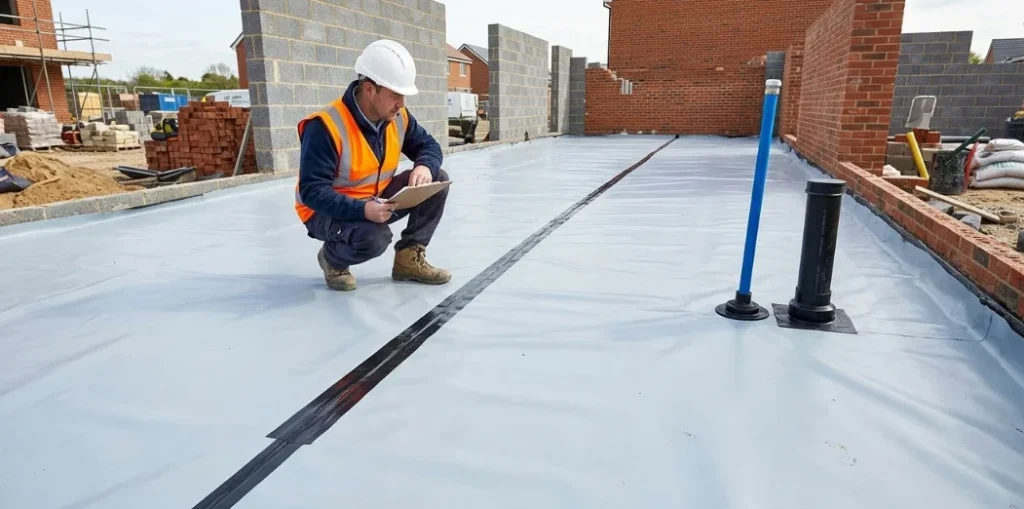
Without verification, there is no way for a local authority, a building control officer, or a future occupier to know whether the gas protection system actually works. Installation errors including incorrectly lapped membranes, unsealed pipe penetrations, damaged sections, or wrong product specifications are common, and they are invisible once the concrete slab is poured.
| Key Point for DevelopersOnce a concrete floor slab is laid, no inspection can assess the integrity of the gas membrane beneath it. Ground gas verification must be carried out during installation, before the next phase of construction covers the work. Appointing a verifier after the slab has been poured is too late and may require expensive opening-up works. |
The Regulatory Framework: BS8485 and CIRIA C735 Explained
Ground gas verification in the UK sits within a framework of British Standards and CIRIA guidance documents that together set out what must be done, how it must be done, and who must do it.
| Standard | What It Covers | Verification Requirement |
|---|---|---|
| BS8485:2015+A1:2019 | Design of gas protection membranes for new buildings | States membranes must be verified in accordance with CIRIA C735 |
| CIRIA C735 (2014) | Testing and verification of gas protection systems | Requires an independent third-party verifier separate from the installer |
| CIRIA C665 (2007) | Assessing risks from hazardous ground gases to buildings | Informs Characteristic Situation (CS) classification and protection level |
| CIRIA C801 (2021) | Hazardous Ground Gas: A Site Management Guide | Supplements CIRIA C735 with updated site management best practice |
The most important point for developers to understand is this: BS8485:2015+A1:2019 explicitly states that gas protection membranes must be verified in accordance with CIRIA C735. This is not advisory. For any site classified as Characteristic Situation 2 (CS2) or above, verification is a condition of planning approval, and your local authority will require a formal verification report before discharging that condition.
CIRIA C735 also includes a critical independence requirement: the verifier must be completely independent of the installation contractor, the material supplier, and the developer. There is no flexibility on this point.
When Does Your Project Need Ground Gas Verification?
The requirement is triggered by the Characteristic Situation (CS) classification assigned to your site following the ground gas risk assessment. BS8485 and CIRIA C665 define four CS levels:
- CS1 is low risk. Simple protective measures may be sufficient, and verification requirements are lighter.
- CS2 is moderate risk. A full gas protection system is required, and independent verification to CIRIA C735 is mandatory. This is the most common scenario on brownfield and former landfill sites in the UK.
- CS3 is high risk. A robust gas protection system is required, typically including active ventilation, with full independent verification.
- CS4 is very high risk. Enhanced protection and verification is required, along with specialist design input.
For CS2 and above, the local planning authority will typically include a condition requiring gas protection measures to be designed, installed, and independently verified before the building can be occupied. The verification report is the document that discharges that condition.
In practice, verification is required on any site where the risk assessment has identified methane, carbon dioxide, radon at levels requiring Building Regulations compliance, or VOCs in the ground, and where a gas protection membrane or ventilation system has been incorporated into the construction design.
What Does the Ground Gas Verification Process Actually Involve?
Many developers appoint a verifier only after the membrane has been installed. By that point the process is already compromised. The correct approach is to appoint an independent verifier before installation begins so they can produce a site-specific Verification Implementation Plan first.
The CIRIA C735 verification process follows five stages:
Stage 1: Verification Implementation Plan
Before any installation begins, the verifier produces a written plan setting out the project-specific conditions, local authority requirements, expected inspection frequency, integrity tests to be carried out, and documentation required at each stage.
Stage 2: Pre-Installation Check
The verifier reviews the gas protection design specification and confirms that the specified materials comply with BS8485:2015+A1:2019. This includes checking that membranes are BBA-certified or equivalent, that the product is appropriate for the CS classification, and that the specification aligns with the planning condition.
Stage 3: Installation Inspections
The verifier attends site during installation to inspect the work as it progresses. This covers membrane laying, lapping, sealing of joints, installation around pipe and service penetrations, continuity at wall-floor junctions, and correct installation of ventilation elements where specified. Photographic records are taken at every inspection.
Stage 4: Integrity Testing
Where required by the CS classification or the local authority, the verifier carries out integrity testing to identify defects that are not visible to the naked eye. The most common methods are air lance testing and electric holiday detection (EHD). Both are non-destructive and are recommended in CIRIA C735 for higher-risk classifications.
Stage 5: Verification Report
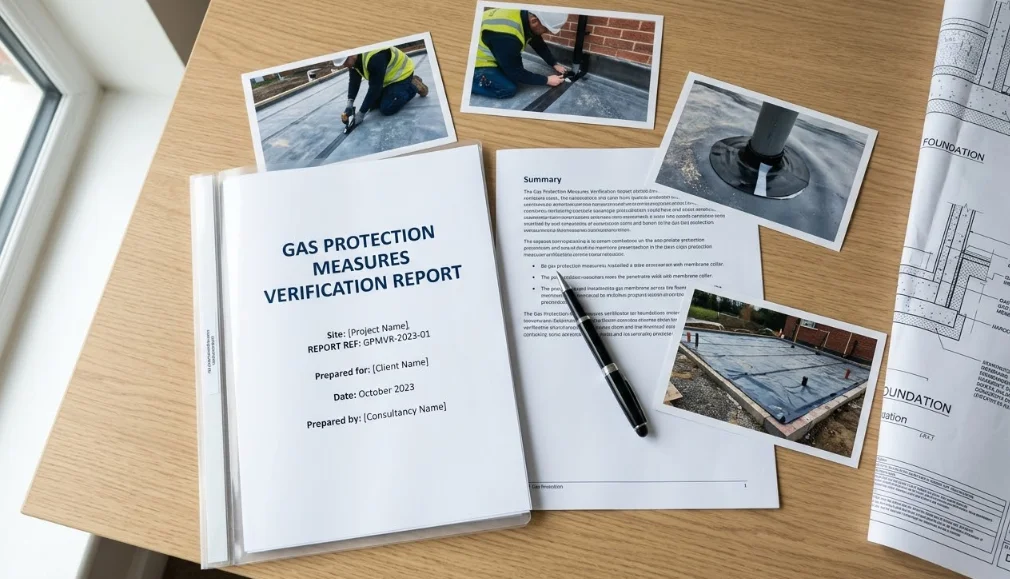
Following all inspections and tests, the verifier produces a formal Gas Protection Measures Verification Report. This document collates all inspection records, test results, photographic evidence, and a statement of compliance. It is submitted to the local planning authority to discharge the gas protection planning condition.
Why the Installer Cannot Verify Their Own Work
This is the most commonly misunderstood aspect of the process. Section 3.2.2 of CIRIA C735 is explicit: the person verifying the membrane must be independent of the installation contractor and the material supplier. This exists because self-certification creates a direct conflict of interest.
| Factor | Installer Self-Certification | Independent Verification |
|---|---|---|
| Independence | None, conflict of interest | Fully independent as required by CIRIA C735 |
| Accepted by local authorities | Often not accepted | Required to discharge the gas planning condition |
| Integrity testing | Rarely undertaken | Carried out per the CIRIA C735 protocol |
| Formal verification report | No standardised format | Issued for planning authority submission |
| Legal protection for developer | Minimal, liability remains open | Evidence of due diligence and compliance |
Local authorities increasingly reject self-certification and require a verification report from a genuinely independent third party before they will discharge the gas protection planning condition.
This also matters commercially. A developer who relies on installer self-certification and later finds that the gas protection system has failed faces significant liability. Independent verification provides documented evidence that every reasonable step was taken to protect the building and its occupants.
What Happens If Verification Is Skipped or Done Incorrectly?
| What developers risk without proper verification:The planning condition cannot be discharged, which means the building cannot be legally occupied. The local authority may require opening-up works to inspect the membrane beneath the slab, adding significant cost and delay. Developer liability remains open if gas-related harm occurs to future occupants. NHBC or warranty provider approval may be withheld. Mortgage lender and conveyancer queries can delay or block property sales. |
Planning conditions linked to ground gas protection are public safety conditions, not administrative formalities. Local authorities in areas with known contamination histories, including former mining regions in the Midlands and the North, landfill-adjacent sites, and former industrial land in major cities, are increasingly rigorous in their review of submitted verification reports.
A poorly produced or incomplete verification report will be rejected, requiring additional site visits, further testing, and resubmission at extra cost and delay. In cases where the membrane has been covered before verification was completed, opening-up works may be required to expose and re-check the installed system.
How Ground Gas Verification Works With Us
Ground Gas Verification provides fully independent gas membrane verification services across the UK, operating in complete independence from membrane manufacturers, installers, and developers. Every verification is carried out in accordance with CIRIA C735 and BS8485:2015+A1:2019.
Whether your project is a residential housing development on a CS2-classified brownfield site, a commercial development near a former landfill, or a mixed-use scheme requiring verification across multiple units, we are ready to help. Get in touch with Ground Gas Verification to discuss your project before installation begins, not after.
If you are unsure whether your site needs verification, read our detailed guide on ground gas risk assessment and Characteristic Situation classifications to understand exactly how your site’s risk level determines the verification requirements.
If you have received a planning condition relating to ground gas protection and need to know what to do next, our step-by-step guide on how to discharge a ground gas planning condition walks through the complete process from verification plan to local authority submission.
For contractors and site managers involved in brownfield housing delivery, our guide on gas membrane installation inspections and what verifiers check explains every stage you need to prepare for on site.
Frequently Asked Questions
| 1. Is ground gas verification a legal requirement?Yes. For any site classified as Characteristic Situation 2 or above, verification is required before the building can be occupied. It is enforced through planning conditions, and the local planning authority will not sign off the condition without a formal Gas Protection Measures Verification Report from an independent verifier. |
| 2. Who is allowed to carry out ground gas verification?The verifier must be completely independent of the gas membrane installer, the material supplier, and the developer. CIRIA C735 is clear on this. They must be a competent specialist with demonstrable experience in ground gas protection. Many reputable verifiers are members of the British Verification Council (BVC) or the CL:AIRE Gas Protection Verification Scheme. |
| 3. What is the difference between gas membrane verification and validation?The two terms are often used interchangeably. In practice, both refer to the CIRIA C735 process of independently inspecting and certifying that the installed gas protection system meets the required standards. If a planning condition or specification uses either term, they are referring to the same independent third-party process. |
| 4. When should I bring in a verifier?Before installation begins. The verifier needs to produce a Verification Implementation Plan before any membrane is laid. If you wait until the installation is complete or, worse, until the slab has been poured, you will not be able to complete a compliant verification without opening up the work and potentially starting again. |
| 5. How many times will the verifier visit my site?The number of visits depends on the CS classification, the size of the project, and what the local authority requires. For a typical CS2 residential development, the verifier will attend at key milestones during installation. A large brownfield scheme with multiple plots will need more frequent visits, one for each plot or construction phase. |
| 6. What is EHD testing and do I need it?EHD stands for Electric Holiday Detection. It is a non-destructive test that identifies pinholes or weak spots in a gas membrane by passing a low-voltage electrical current across the surface. Air lance testing does the same thing for laps and joints. Whether you need these tests depends on your CS classification and your local authority. Your verifier will confirm this in the Verification Implementation Plan. |
| 7. What is actually in a gas verification report?The report includes a summary of the project and the gas protection design, the verification plan, all site inspection records, photographic evidence from every visit, integrity test results, a record of any issues found and how they were resolved, and a formal statement confirming the installed system complies with BS8485:2015+A1:2019. This is the document you submit to your local planning authority. |
| 8. Can the company that installs the membrane also verify it?No. CIRIA C735 does not allow this. The verifier must be independent of the installer and the supplier. Any report produced by the installing contractor or a company linked to them will be rejected by most local planning authorities and does not satisfy the current UK guidance requirements. |
| 9. Does radon protection need to be independently verified as well?Yes. Where a radon protection system is required under Part C of the Building Regulations or as a planning condition, the same principles of independent verification apply. This is increasingly relevant as more sites fall within high-radon areas identified on the updated UK Health Security Agency radon map. |
| 10. Does every brownfield housing development need ground gas verification?Not every single one, but the vast majority will. Most brownfield sites in the UK require at minimum a ground gas risk assessment. If that assessment classifies the site as CS2 or above, a gas protection system is required and independent verification follows. With England’s brownfield land capable of delivering over 1.4 million homes according to CPRE data, ground gas verification is now a standard part of residential construction delivery. |
The Bottom Line for Developers
Ground gas verification is not a box-ticking exercise. It is the documented proof that the invisible protective barrier between the ground beneath your building and the people who will live or work in it has been correctly installed and independently checked. Without it, your planning condition cannot be discharged, your building cannot be occupied, and your liability as a developer remains open.
With UK brownfield development accelerating to meet government housing targets and local authorities becoming more thorough in their review of planning condition submissions, the quality of ground gas verification matters more than it ever has. Appointing a genuinely independent, CIRIA C735-compliant verifier at the right stage of your project protects your investment, your timeline, and the safety of future occupants.