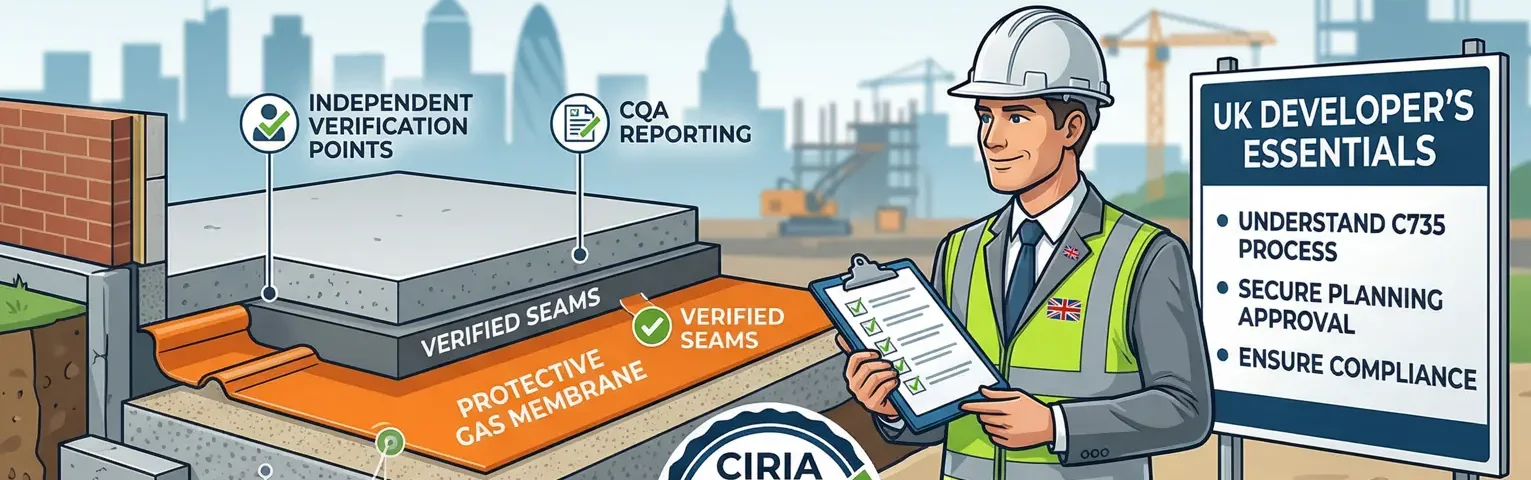
If your project sits on ground that carries a gas risk, you will at some point encounter the name CIRIA C735. It will appear in planning conditions, in letters from local authority contaminated land officers, in membrane installation specifications, and in conversations with environmental consultants. But most developers who hear it cannot tell you what it actually says, why it exists, or what it means for their project in practical terms.
This guide gives you that information clearly. What CIRIA C735 is, where it sits in the UK regulatory landscape, what it requires from developers, installers, and verifiers, and exactly what you need to do to satisfy it on your site.
The guidance is 129 pages long and was written for designers, installers, verifiers, and regulators. This article extracts the parts that matter most to developers who are working to discharge a planning condition or making sure their project is compliant before problems arise.
What Is CIRIA C735 and Where Does It Come From?
CIRIA C735, formally titled Good Practice on the Testing and Verification of Protection Systems for Buildings Against Hazardous Ground Gases, was published in August 2014 by the Construction Industry Research and Information Association (CIRIA). It was authored by Hugh Mallett, Louise Cox, Stuart Wilson, and Mick Corban. Its ISBN is 978-0-86017-739-5 and it runs to 129 pages.
The document was recognised immediately as a significant contribution to the industry. In 2014 it won a Highly Commended award at the Brownfield Briefing Awards in the Best Scientific or Verification Advancement category, one of only four entries to receive the accolade from a field of over 70 projects.
CIRIA itself was frank about why the guidance was needed. In the document’s own introduction, the organisation states that there is evidence that the installation of many gas protection systems has failed to meet an acceptable standard. This was not a theoretical concern. The first guidance on installing gas protection systems was published in the early 1990s, and by 2014, after two decades of increasing brownfield development, the quality of those installations had become a recognised problem across the industry.
CIRIA C735 was the industry’s formal response to that problem. It created, for the first time, a coherent and detailed framework for verifying that a gas protection system has actually been installed to the required standard, not just designed to meet it.
How CIRIA C735 Connects to BS8485 and Why Both Matter
CIRIA C735 does not operate in isolation. It sits within a framework of British Standards and other guidance documents that together govern how gas risk is assessed, how gas protection systems are designed, and how they must be installed and verified. Understanding where C735 fits in that framework is essential before you can understand what it requires.
| Document | Published By | What It Covers |
|---|---|---|
| CIRIA C665 (2007) | CIRIA | Assessing risks posed by hazardous ground gases to buildings. Establishes the Characteristic Situation (CS) classification system from CS1 to CS4. |
| BS8485:2015+A1:2019 | British Standards Institution | Code of practice for the design of gas protection membranes for new buildings. Explicitly requires membranes to be verified in accordance with CIRIA C735. |
| CIRIA C735 (2014) | CIRIA | Good practice on testing and verification of gas protection systems. The primary compliance reference for planning authorities on verification. |
| CIRIA C748 (2014) | CIRIA | Guidance on the use of plastic membranes as VOC vapour barriers. Relevant for sites with volatile organic compound contamination. |
| CIRIA C801 (2021) | CIRIA | Hazardous Ground Gas: A Site Management Guide. Supplements C735 with updated site management and monitoring practice. |
The critical connection is between BS8485 and CIRIA C735. BS8485:2015+A1:2019 is the British Standard that governs the design of gas protection membranes for all new buildings in the UK. That standard contains a direct requirement: membranes must be verified in accordance with CIRIA C735. This is not a cross-reference or a recommendation. It is a requirement built into the Standard that planning authorities rely on when setting and enforcing planning conditions.
In practice this means that if your site has a gas protection membrane, BS8485 applies to its design, and BS8485 in turn mandates that you follow CIRIA C735 for its verification. The two documents are inseparable in a compliant gas protection strategy.
The Six Core Principles of CIRIA C735 That Developers Must Understand
CIRIA C735 is a detailed technical document, but it is organised around a set of clear principles. These are the points that planning authorities, contaminated land officers, and independent verifiers will be checking your project against. Each one has a direct practical implication for how your project should be managed.
1. Verification must start at the design stage
CIRIA C735 states that the verification plan should be written at the design stage, not once installation has begun or finished. The plan is an integral part of the gas protection design, not an afterthought. It must be produced before any membrane is laid and must be approved by the relevant regulatory authority before works progress. On sites where local authority oversight is required, the regulator should be involved as early as possible in the development and planning stages.
2. Verification is as important as design and installation
This is stated explicitly in CIRIA C735 and it reflects a shift in industry thinking that the document formalised. Before C735, design and installation were generally treated as the two critical stages. C735 established verification as the third, equally weighted stage. A perfectly designed and correctly installed membrane that has not been independently verified provides no documented assurance to the planning authority, the building owner, or future occupants.
3. An independent third party must carry out the verification
CIRIA C735 is unambiguous on this point. A risk-based approach to verification is required, and an independent third party should be used to avoid conflicts of interest. The verifier cannot be the installation contractor, a company within the same group, or anyone with a financial interest in the installation being declared compliant. This requirement is what makes installer self-certification non-compliant with C735, regardless of how thorough the installer believes their check to have been.
4. Installer qualification directly affects verification intensity
Section 3.3 of CIRIA C735 deals with installer competence in direct terms. It states that appropriately experienced and qualified operatives must be employed on site to install gas protection systems. A qualified installer is defined as someone holding an NVQ Level 2 Diploma in gas membrane installation or a TWI/CSWIP accreditation for plastic welding. If unqualified operatives are used, the guidance requires that more onerous and intensive verification activities are planned and carried out. In practical terms, this means more inspections, more testing, and significantly more cost. The relationship is straightforward: a qualified installer reduces the verification burden; an unqualified one amplifies it.
5. Integrity testing must be used alongside visual inspection
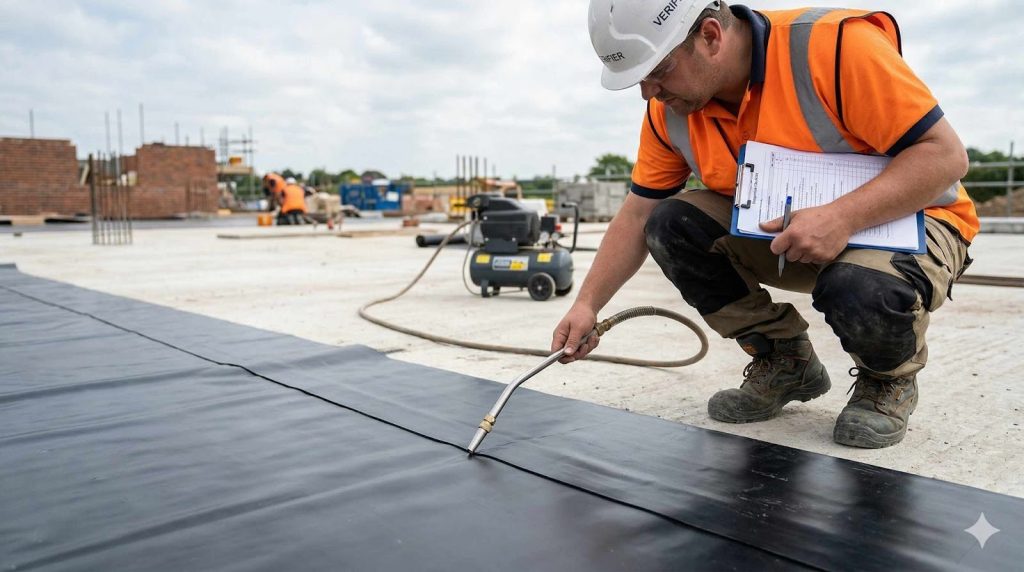
CIRIA C735 is explicit that visual inspection alone is not sufficient. Integrity testing must be used as well as visual inspection to demonstrate a gas-tight seal is present across the membrane. The two main methods referenced in C735 are air lance testing, which directs pressurised air along joints and seams to locate gaps, and electric holiday detection (EHD), which uses a low-voltage electrical current across the membrane surface to identify pinholes and thin spots. Both are non-destructive and both are carried out in accordance with ASTM D4437. The need for integrity testing and which method is appropriate is determined by the risk-based assessment in the Verification Implementation Plan.
6. Ventilation systems must be verified too
CIRIA C735 makes clear that ventilation is regarded as a very effective initial line of defence against ground gas, but it must be verified in the same way as a membrane. Developers who assume that a ventilated void or sub-floor ventilation system is automatically adequate without independent verification are mistaken. The specification, installation, and performance of any ventilation element must be documented as part of the verification process.
The Verification Implementation Plan: What It Must Include
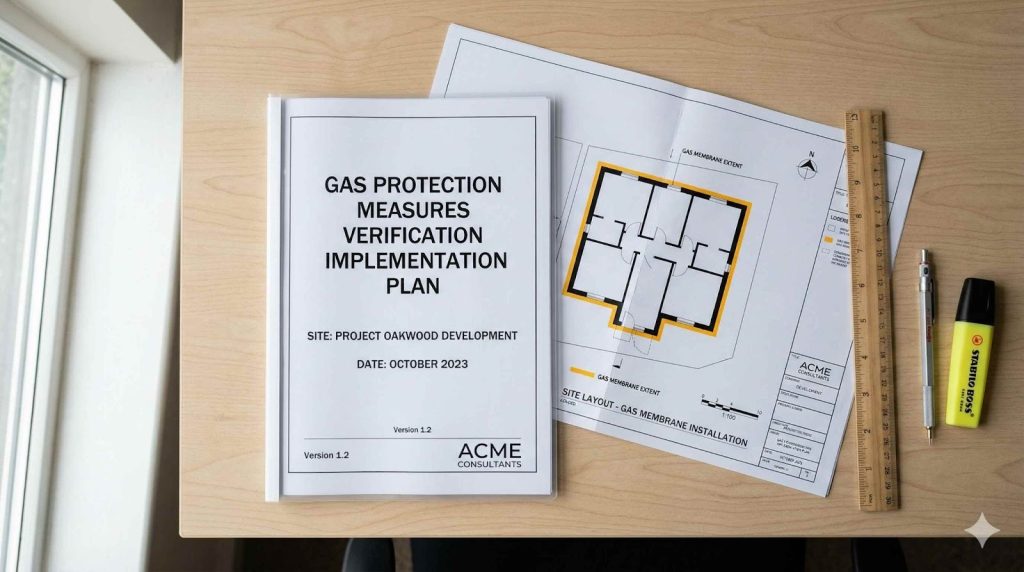
The Verification Implementation Plan (VIP) is a mandatory document under CIRIA C735, and it must be prepared before any installation begins. It acts as a formal agreement between the developer, independent verifier, and regulator on how verification will be carried out for the project.
CIRIA C735 requires the plan to consider four key site-specific factors:
- Ground gas risk identified in the assessment
- Number and type of buildings
- Complexity of the gas protection system
- Installer experience and qualifications
These factors determine the level of inspection and testing required.
For a typical CS2 residential project, the plan outlines inspection stages, testing methods, documentation at each visit, and the structure of the final report. Higher-risk sites (CS3/CS4) or less experienced installers require more intensive verification.
The plan must be approved by the regulatory authority before installation starts. CIRIA C735 also provides guidance on inspection frequency (Annex 1) and recommends using the Appendix A proforma to record each visit, ensuring consistent, compliant documentation.
| What local authorities are checking forWhen a local planning authority receives a gas protection planning condition discharge submission, their contaminated land officer or environmental health officer will check whether a Verification Implementation Plan was produced before installation began, whether the verifier is demonstrably independent of the installer, whether the inspection programme matches what C735 requires for the site’s CS classification, whether integrity testing was carried out where required, and whether the final verification report follows the structure set out in C735 and contains photographic evidence from all inspection visits. Missing any of these elements is the most common reason submissions are rejected. |
Who Is Qualified to Verify to CIRIA C735?
Under CIRIA C735, a verifier must be both competent and independent. Competence means proven knowledge of gas protection systems, installation practices, integrity testing, and planning authority requirements.
The most recognised way to demonstrate this in the UK is through the CL:AIRE Gas Protection Verification Accreditation Scheme (GPVS). Introduced to improve industry standards, it’s supported by regulators like the Environment Agency and referenced in government land contamination guidance as best practice.
GPVS has two levels:
- TGPV (Technician): Carries out on-site inspections
- SGPV (Specialist): Manages the process and signs off the final report
Only an SGPV-accredited verifier can approve the full verification report. Reports issued with a CL:AIRE Quality Mark provide a traceable, auditable record—significantly reducing the risk of rejection by planning authorities.
What the Final CIRIA C735 Verification Report Must Include
The Gas Protection Verification Report is the key document used to discharge a planning condition. Under CIRIA C735, it must follow a strict structure—missing elements are a common cause of rejection.
A compliant report should include:
- Project overview: Site details, Characteristic Situation (CS classification), gas protection design, and the planning condition being discharged
- Verification Implementation Plan (VIP): Confirmation it was agreed before installation
- Full inspection records: Every site visit documented using Appendix A proforma (dates, attendees, checks, conditions)
- Photographic evidence: Membrane installation, joints, penetrations, junctions, and testing stages
- Integrity testing results: Method used, coverage, and outcomes (where required)
- Non-conformance log: Issues identified, remedial actions taken, and verification of fixes
- Compliance statement: Formal confirmation that the system meets BS8485:2015+A1:2019 and has been verified in line with CIRIA C735
Important: This report should be built throughout the project, not created at the end. Each inspection feeds directly into it. A retrospective report without proper staged inspections is non-compliant and likely to be rejected by the local authority.
What Developers Most Commonly Get Wrong About CIRIA C735
Having worked on sites across the UK and reviewed submissions that have been rejected by local planning authorities, the same mistakes appear repeatedly. Understanding them in advance is the most straightforward way to avoid them.
Treating CIRIA C735 as an optional enhancement rather than a requirement
Some developers, particularly those who have worked on gas-affected sites before 2014 or who are using older environmental consultants, still treat C735 as guidance that can be applied selectively. It is not optional for CS2 and above. BS8485:2015+A1:2019, the British Standard for membrane design, requires compliance with C735 directly. The planning condition that references BS8485 therefore also requires compliance with C735, whether or not C735 is named explicitly in the condition.
Appointing the verifier after the membrane is installed
This is the single most common practical error. The Verification Implementation Plan must be produced and approved before installation begins. A verifier brought in after installation cannot have produced that plan. They cannot have witnessed the membrane in its substrate preparation phase. They cannot confirm the condition of the membrane before follow-on trades worked over it. A retrospective verification process does not satisfy C735 and will not satisfy a thorough local authority officer.
Assuming the same company can install and verify
The independence requirement in C735 section 3.2.2 is clear and absolute. Any verification carried out by the installing contractor, by a parent or subsidiary company of the installer, or by any person with a financial relationship to the installation is non-compliant. Local planning authorities are increasingly aware of this and will question relationships between installers and verifiers when reviewing submissions.
Submitting Without Integrity Test Results
One of the most common reasons for rejection is missing integrity test results. Under CIRIA C735, verification requires both visual inspections and integrity testing.
For most sites, especially CS2 and above—this includes:
- Air lance testing for joints and penetrations
- EHD testing for the membrane field (where required)
If your submission only includes photos and inspection records but no test results, it will be considered incomplete and returned for further work.
| Need a CIRIA C735-compliant verification for your project?Ground Gas Verification provides fully independent gas membrane verification across the UK, with no commercial connection to any installer or membrane manufacturer. Every verification follows the CIRIA C735 process from Verification Implementation Plan through to final report. Contact us at groundgasverification.co.uk before your installation begins. |
Frequently Asked Questions (FAQs) About CIRIA C735
What is CIRIA C735?
CIRIA C735 is a UK industry guidance document that defines how gas protection systems are independently tested and verified. It provides the standard framework for ensuring membranes and ventilation systems are correctly installed and compliant with planning requirements, especially when referenced alongside BS8485:2015+A1:2019.
Is CIRIA C735 legally required?
CIRIA C735 itself is guidance, not law. However, when planning conditions require compliance with BS8485, verification must follow C735. In practice, this makes C735 effectively mandatory for sites classified as CS2 or higher.
What is a Verification Implementation Plan (VIP)?
A Verification Implementation Plan is a document prepared before installation begins by an independent verifier. It outlines inspection stages, testing methods, documentation, and approval workflow. It must be agreed with the regulatory authority in advance.
How do I know if my site requires CIRIA C735 verification?
It depends on the site’s Characteristic Situation (CS) classification from the ground gas risk assessment. Sites classified as CS2 or above, common for brownfield, landfill, and former industrial land, require independent verification under C735.
What qualifications should a CIRIA C735 verifier have?
A verifier must be competent and independent, with proven experience and ideally accreditation through the CL:AIRE Gas Protection Verification Accreditation Scheme. The Specialist in Gas Protection Verification (SGPV) level is required to sign off final reports.
Does CIRIA C735 apply to radon protection systems?
Yes. If radon membranes are installed under planning conditions or Building Regulations, C735 principles still apply, covering independence, inspection stages, testing, and reporting.
What is the difference between visual inspection and integrity testing?
- Visual inspection: Physical checks of laps, joints, penetrations, and installation quality at each stage
- Integrity testing: Technical testing to detect hidden defects using methods like air lance and electric holiday detection (EHD)
CIRIA C735 requires both methods together for full compliance.
Why do planning authorities require CIRIA C735 compliance?
Local planning authorities include C735 in conditions because it is the UK’s recognised standard for gas membrane verification. Many authorities and regional bodies reference it in their contaminated land guidance, making compliance essential for planning discharge.
The Bottom Line for Developers
CIRIA C735 is the document that tells you, your installer, your verifier, and your local planning authority what good gas membrane verification looks like. It has been the governing guidance since 2014 and it is embedded in the British Standard that applies to every gas protection membrane designed and installed on new buildings in the UK.
For developers, the practical takeaway is straightforward. If your site is classified CS2 or above, you need an independent verifier appointed before installation begins, a Verification Implementation Plan approved before any membrane is laid, inspections at each construction milestone, integrity testing where the plan requires it, and a final report that follows the structure and content requirements of CIRIA C735.
None of those steps can be skipped without creating a real risk that your planning condition will not be discharged and your building cannot legally be occupied. Getting them right, by appointing a genuinely independent and competent verifier at the earliest possible stage, protects your programme, your approval, and the safety of every person who will eventually occupy the building you are delivering.