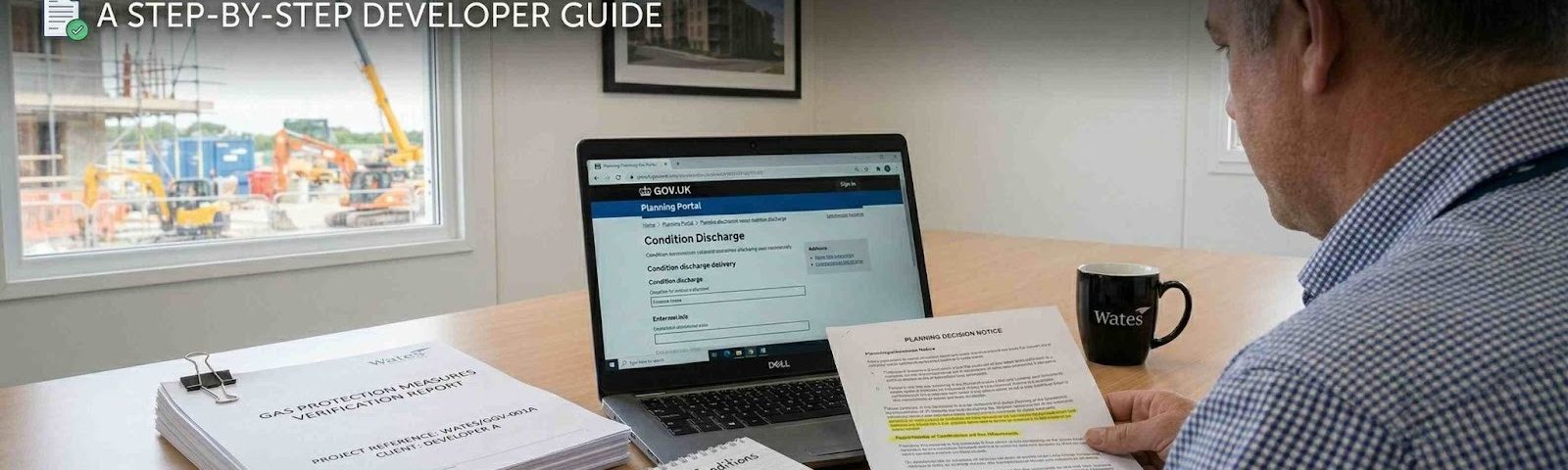
Receiving planning permission is one milestone. Discharging the conditions attached to it is an entirely separate process, and for developers on sites with a ground gas risk, it is the stage where projects most commonly stall, face delay, or attract unexpected cost.
A ground gas planning condition sits on your permission for a reason. The local planning authority identified that gases in the ground beneath your site could migrate into the buildings you are constructing and pose a risk to occupants. The condition will not be discharged until they are satisfied that you have dealt with that risk properly. Submitting incomplete documentation, using the wrong verifier, or getting the timing of your submission wrong are all common reasons why conditions get rejected and programmes get delayed.
This guide walks you through the complete process from reading the condition wording in your decision notice all the way through to receiving written approval from the local planning authority. Every stage is covered in the order it needs to happen. If you follow it, you will not be among the developers who find out at the last minute that their gas protection work cannot be signed off.
Step 1: Read Your Planning Condition Wording Carefully
The starting point is your decision notice. Every planning condition is unique to the site and the authority that issued it, and ground gas conditions vary significantly in their wording, their requirements, and their timing. Before doing anything else, you need to understand exactly what your condition says.
Ground gas planning conditions typically fall into two types. The first is a pre-commencement condition, which must be discharged before any development begins, including groundworks and demolition. These conditions usually require a gas protection design scheme to be submitted and approved before work starts on site. The second is a pre-occupation condition, which must be discharged before the building can be legally occupied or brought into use. These conditions typically require a completed gas protection measures verification report to be submitted and approved before anyone moves in.
In practice, a site with a significant gas risk may carry both types. A common condition structure seen across local planning authorities in England runs like this: a pre-commencement condition requires submission of a gas protection design scheme including a verification methodology, and a separate pre-occupation condition requires submission of a verification report confirming the protection measures were installed and verified in accordance with that approved scheme and in line with CIRIA C735.
| Real condition wording to look out for Reigate and Banstead Borough Council, one of several local authorities that publish their contaminated land planning guidance publicly, uses condition wording that includes: ‘Prior to occupation, a suitably detailed ground gas verification report shall be submitted and approved in writing by the Local Planning Authority prior to occupation. The verification report should include but not be limited to photographic evidence demonstrating the quality of works undertaken and be able to demonstrate the gas mitigation and protection measures have been installed and validated by a suitably qualified person.’ This type of wording is standard across many English local authorities. |
The key things to identify in your condition wording are: which guidance documents are referenced by name (BS8485, CIRIA C735, BR414), what the condition requires you to submit, when the submission must be made relative to your programme, and whether the condition specifies requirements about the independence or qualifications of the verifier.
Step 2: Understand Which Documents You Need to Submit
Many ground gas planning conditions are written in two stages. The first submission is typically required before works begin and covers the gas protection design scheme. The second submission is required before occupation and covers the verification of the installed system. Getting both submissions right is essential.
The Gas Protection Design Scheme
This document is produced by your environmental consultant or gas protection designer and sets out the proposed gas protection measures for the site. A well-prepared scheme that satisfies the local planning authority will typically include the site’s Characteristic Situation classification from the ground gas risk assessment, the proposed gas protection system including membrane specification, ventilation arrangements where applicable, and how service penetrations will be managed. It should also include details of how the scheme will be verified, naming the independent verifier and setting out the verification methodology in line with CIRIA C735.
The Verification Implementation Plan
CIRIA C735 requires the independent verifier to produce a Verification Implementation Plan before any installation begins. Some local authorities require this to be submitted as part of the pre-commencement package or approved alongside the design scheme. Others require it to be agreed between the verifier and their contaminated land officer before works start on site. Either way, it must exist and must be agreed before the membrane goes down. This plan sets out the inspection milestones, integrity testing requirements, and documentation that will build up into the final verification report.
The Gas Protection Measures Verification Report
This is the document submitted to discharge the pre-occupation condition. It is produced by the independent verifier after all installation and inspection work has been completed. A compliant report under CIRIA C735 includes the approved design scheme and verification plan as its starting point, then layers in inspection records from every site visit using the Appendix A proforma from CIRIA C735, photographic evidence from each inspection showing the membrane at every critical stage, integrity test results where testing was required, a record of any non-conformances and how they were resolved, and a formal compliance statement confirming the installed system meets BS8485:2015+A1:2019.
| Submission Stage | Document Required | Submitted To |
|---|---|---|
| Pre-commencement | Gas Protection Design Scheme including verification methodology | Planning case officer or contaminated land officer |
| Before installation begins | Verification Implementation Plan (CIRIA C735) | Agreed with contaminated land officer and independent verifier |
| Pre-occupation | Gas Protection Measures Verification Report (CIRIA C735 compliant) | Planning portal or directly to contaminated land officer |
| At any stage if required | Integrity test records (air lance or EHD results) | Included within or appended to the verification report |
Step 3: Appoint Your Independent Verifier Before Installation Starts
This is where many developers go wrong. An independent verifier must be appointed before installation begins, not after. CIRIA C735 clearly requires the Verification Implementation Plan to be in place in advance, meaning the verifier should be appointed, briefed, and agreed with the local authority before the membrane contractor arrives on site.
The verifier must be fully independent of the installer, material supplier, or any party with a commercial interest. This requirement ensures installers cannot verify their own work, and local authorities increasingly check these relationships during submission reviews.
When choosing a verifier, prioritize proven experience in gas membrane verification and, ideally, accreditation under the CL:AIRE Gas Protection Verification Accreditation Scheme (GPVS). The highest level, Specialist in Gas Protection Verification (SGPV), is required to sign off the final report. A report with a CL:AIRE Quality Mark provides a clear, auditable record and reduces the risk of planning challenges.
Step 4: Manage the Installation to Support the Verification
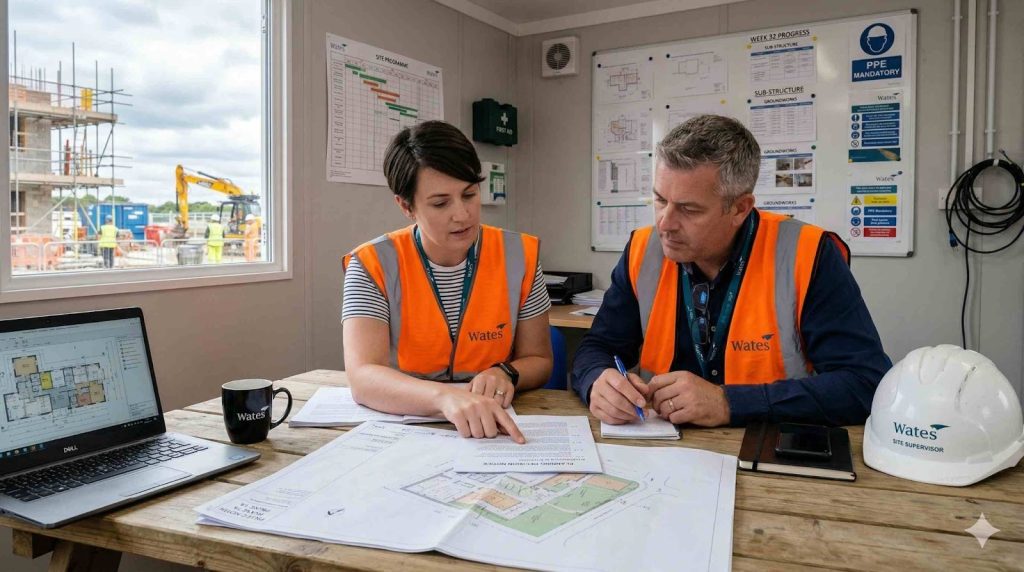
Once the verifier is appointed and the Verification Implementation Plan agreed, the focus shifts to managing installation so verification can be properly carried out. This requires active involvement from the developer and main contractor, not just the gas membrane installer.
The key requirement is that the verifier must inspect the membrane at each critical stage before it is covered. If works like concrete pouring proceed before inspection, the chance for a compliant CIRIA C735 inspection is lost. This is common on fast-paced sites and often leads to issues during planning discharge.
CIRIA C735 defines essential inspection stages for a typical CS2 residential project, including: substrate checks before installation, monitoring membrane installation (laps and joints), inspection of service penetrations, wall-floor junction checks, and final inspection before concrete is poured. All inspections must be recorded using the standard Appendix A proforma.
Developers are also responsible for ensuring all site personnel and follow-on trades are aware of the membrane, understand it must not be damaged, and know how to report issues. Many local authorities require proof of these measures as part of compliance submissions.
Step 5: Complete Integrity Testing Where Required
Visual inspection is not sufficient on its own under CIRIA C735. Integrity testing must be carried out alongside visual inspection to demonstrate that a gas-tight seal is present across the membrane. The need for integrity testing, the method to be used, and the coverage required will be set out in the Verification Implementation Plan.
The two methods used in the UK are air lance testing and electric holiday detection (EHD). Air lance testing involves directing a pressurised air stream along joints, seams, and penetration details to identify any gaps or inadequately bonded areas. EHD testing passes a low-voltage electrical charge across the membrane surface to locate pinholes and thin spots that are invisible to the eye. Both are non-destructive, both are referenced in CIRIA C735 and ASTM D4437, and both generate documented results that are included in the final verification report.
The verifier will confirm which method is appropriate for the specific membrane type installed. Some membranes are not electrically conductive and cannot be tested with EHD, making air lance testing the appropriate method for joints and penetrations. The verifier needs to know the membrane specification before the Verification Implementation Plan is finalised, which is another reason why late verifier appointment creates problems.
Step 6: Submit the Verification Report and Apply to Discharge the Condition
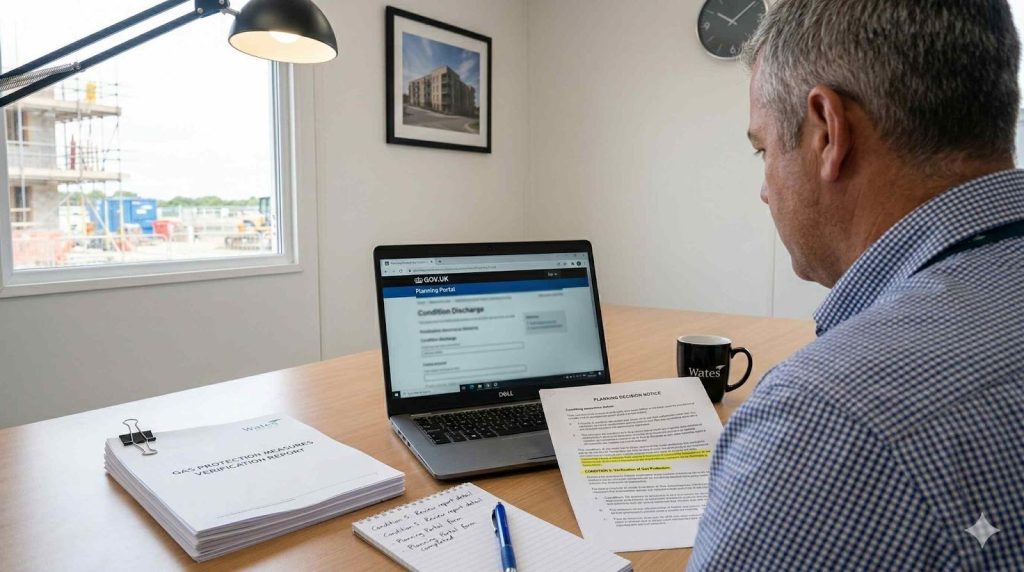
Once inspections are complete and the verification report is ready, the condition discharge application is submitted via the Planning Portal UK. In England, the current fee is £116 per submission for non-householder developments, and multiple conditions can be included in one application if needed.
Under the Town and Country Planning (Development Management Procedure) (England) Order 2015, local authorities must respond within 8 weeks of a valid submission. If no decision is made within 12 weeks, the fee must be refunded. In practice, delays are common, so build realistic timelines into your programme.
To avoid rejection, clearly label all documents with the planning reference and condition number. If submitting multiple conditions, include a document register showing which file relates to each condition. Authorities like South Hams District Council require this and may not process poorly organised submissions.
| What the local authority officer is checkingWhen your submission lands with the contaminated land officer or environmental health officer responsible for your site, they will check whether a Verification Implementation Plan was produced and agreed before installation began, whether the verifier named in the report is genuinely independent of the installer, whether the inspection records use the CIRIA C735 Appendix A proforma or equivalent, whether photographic evidence covers every required milestone, whether integrity testing results are included where the CS classification requires it, and whether the compliance statement formally confirms BS8485:2015+A1:2019 compliance. Any of these being missing is grounds for rejection. |
What Happens If the Condition Is Rejected
If a submission does not meet requirements, the local authority will issue a rejection outlining what is missing. This means a resubmission is needed, along with another £116 fee, and sometimes additional site work.
Common reasons for rejection include: lack of verifier independence, missing inspection records, absent integrity test results, failure to reference BS8485:2015+A1:2019 and CIRIA C735, and incomplete or poorly labelled photos. Submissions may also fail if the verifier lacks proper qualifications or if the Verification Implementation Plan was created retrospectively.
In serious cases, especially where the membrane is already covered, authorities may require opening-up works to inspect it. This is costly, delays the programme, and is entirely avoidable with proper verification from the start.
For a complete overview of ground gas verification, from risk assessment to sign-off, see our guide on what it involves and when it’s required. If you’re selecting a system, our inspection guide explains what verifiers check at each stage. You can also explore why installer independence matters and review a plain-English breakdown of CIRIA C735 for developers.
Frequently Asked Questions
When do you need to discharge a ground gas planning condition?
Most ground gas planning conditions are pre-occupation, meaning approval is required before you can legally use or occupy the building. Some sites also include pre-commencement conditions, which must be approved before any work starts. Always check your decision notice to avoid delays.
What is the fee to discharge a planning condition in England?
The standard fee is £116 per submission for non-householder developments. You can include multiple conditions in one application. Authorities typically respond within 8 weeks.
Can you occupy a building before gas condition discharge approval?
No. If it’s a pre-occupation condition, using the building before approval is a breach of planning control. This can lead to enforcement action, fines, or restrictions on property use or sale.
What if the council takes longer than 8 weeks?
Legally, a decision should be made within 8 weeks. After 12 weeks, the fee must be refunded. There is also a “deemed discharge” option under Town and Country Planning (Development Management Procedure) (England) Order 2015, but it often does not apply to contaminated land or gas protection conditions, so expert advice is recommended.
Can you submit gas verification with other planning conditions?
Yes. The Planning Portal UK allows multiple conditions in one submission. Just include a clear document list showing which file relates to each condition, this avoids rejection.
What happens if your submission is rejected?
You’ll receive a rejection letter explaining the issues. You must fix them and resubmit with another £116 fee. In serious cases, you may even need opening-up works if inspections were missed.
Do all plots need gas verification?
Usually, yes. For multi-plot developments, most authorities expect every plot to be verified. Any alternative approach must be agreed in advance with the local authority.
Is verification required even if the membrane was installed correctly?
Yes. The condition requires independent verification, not just proper installation. Without documented proof, the condition is not satisfied, no matter how good the work is.
What does a contaminated land officer do?
A contaminated land officer reviews your submission and decides if the ground gas condition discharge is acceptable. Engaging them early can reduce rejection risk and speed up approval.
How Ground Gas Verification Takes the Stress Out of Condition Discharge
Discharging a ground gas planning condition involves multiple critical steps, interpreting the condition, preparing the right documents, appointing an independent verifier early, managing site inspections, completing integrity testing, and submitting a compliant report aligned with CIRIA C735. Missing any step can lead to rejection, delays, or costly opening-up works.
Ground Gas Verification handles the entire process for you. From initial appointment to final approval, everything is managed to ensure a smooth, compliant outcome:
- Preparation of the Verification Implementation Plan before installation
- Site attendance at every required CIRIA C735 inspection stage
- Air lance and EHD integrity testing (where required)
- Full inspection records using Appendix A proforma with photographic evidence
- Delivery of a planning-ready Gas Protection Verification Report
We operate with complete independence, no ties to membrane manufacturers or installers, ensuring unbiased, compliant verification that planning authorities trust.Whether you’re working on a multi-plot residential development, a complex mixed-use site, or a commercial project near contaminated land, the process is aligned with your construction programme to avoid disruption.