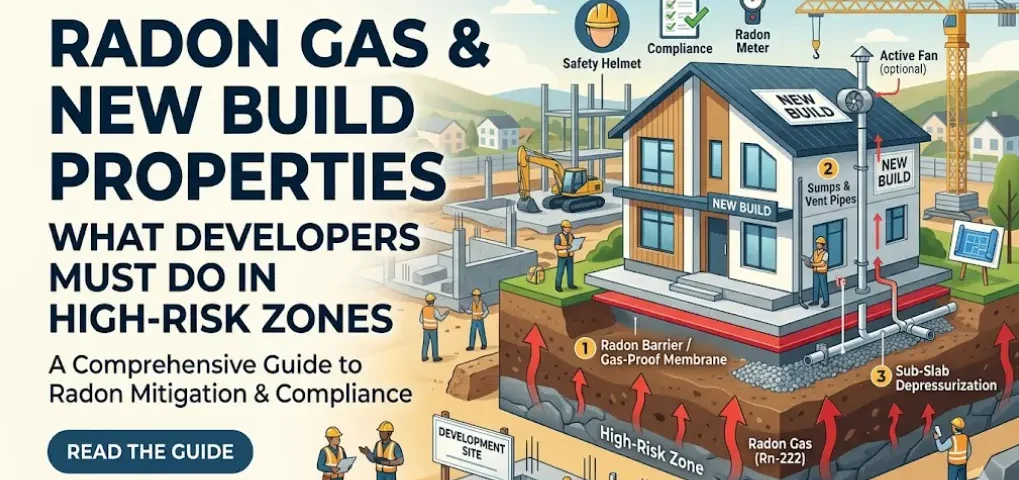
Radon is responsible for 1,100 lung cancer deaths in the UK every year, according to UKHSA. It is colourless, odourless, and undetectable without testing. And for developers building in high-risk zones, it is a Building Regulations compliance requirement that carries real planning and liability consequences if ignored.
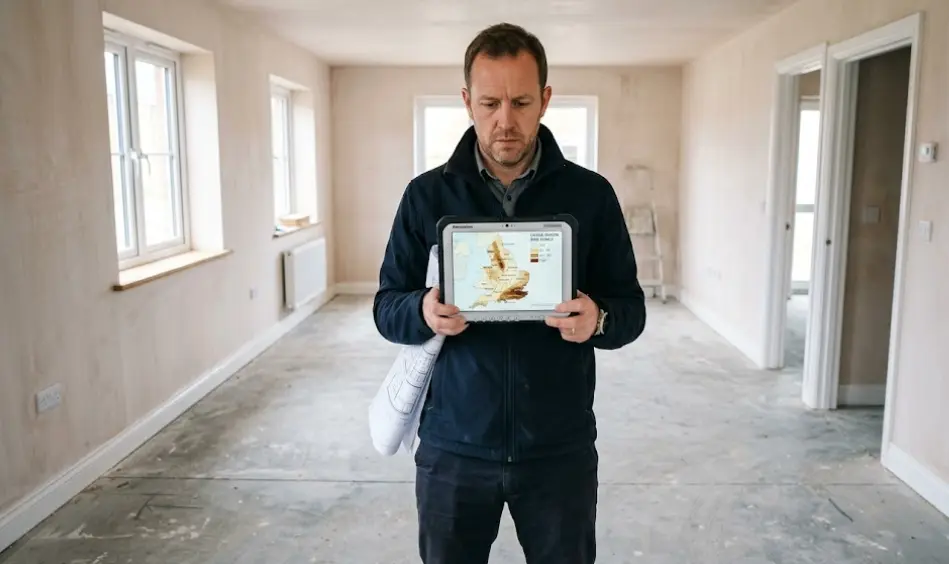
The risk landscape shifted in December 2022 when UKHSA and the British Geological Survey published the first update to the Great Britain radon potential map in more than ten years. Using refined geological data and a far larger database of in-home measurements, the updated map reclassified the radon risk profile of thousands of sites. Some areas previously considered low risk moved into affected area status. Developers who last checked the map before December 2022 may be building to the wrong specification.
This guide explains what radon is, how to determine what your site requires, exactly what Building Regulations now mandate, what BRE BR211 2023 changed, and why independent verification of the installed system is a requirement, not an optional extra.
What Radon Is and How It Gets Into Buildings
Radon is a naturally occurring radioactive gas produced by the decay of uranium in rocks and soils. It exists in all rocks and soils in trace amounts, but concentrations vary enormously depending on the underlying geology. Granite bedrock, which is found extensively in Cornwall, Devon, parts of Wales, Derbyshire, and areas of Scotland, produces radon at much higher rates than sedimentary rock. As radon is generated in the ground it migrates upward through permeable soils and into buildings through any pathway it can find.
The primary entry routes into new buildings are cracks and joints in concrete ground floor slabs, gaps around service pipes and cables passing through the floor, and suspended timber floors with inadequate underfloor ventilation. Once inside a building, particularly in lower ground floor levels, basements, and spaces with limited air exchange, radon accumulates. The longer occupants spend in those spaces, the greater their cumulative radiation dose.
The UK action level for radon is 200 Becquerels per cubic metre (Bq/m3), the concentration at which UKHSA recommends that remedial action be taken. The target level following remediation is 100 Bq/m3. The UK average in homes is 20 Bq/m3, which means action level properties are ten times higher than average. In the darkest areas on the UKHSA radon map, more than one in three buildings is estimated to exceed the action level.
The Updated UKHSA Radon Map: What Changed in December 2022
The December 2022 map update was the most significant revision to radon risk mapping in the UK since 2007. UKHSA and BGS produced it using three key methodological improvements over the previous version.
First, the database of in-home radon measurements used to calibrate the map grew substantially. Second, more accurate and detailed geological mapping data from BGS was incorporated, with the minimum number of measurements needed to classify a geological type reduced from 100 to 30, allowing smaller and more precisely bounded geological units to be mapped individually. Third, the 50-metre geological buffer previously applied around high-risk areas was removed, making zone boundaries more precise and reducing the number of false-positive affected area designations at zone edges.
The practical result is a more accurate map. Some areas that previously sat inside a broad affected area because of the buffer zone are now correctly shown as lower risk. More significantly for developers, some areas that previously fell just outside affected area boundaries are now correctly included. The overall number of buildings estimated to have elevated radon levels across the UK has not changed, but their geographic distribution is more precisely defined.
| Why this matters for developers building now If your site was assessed using the pre-December 2022 radon map, the risk classification may no longer be correct. The UKHSA interactive radon map at ukradon.org allows individual address-level checks. A £3.90 address-specific report from UKHSA gives the precise estimated percentage of properties in that location expected to exceed the 200 Bq/m3 action level. Using an outdated risk assessment to determine your protection specification leaves you exposed if the current map shows a higher risk. |
What Building Regulations Require: Approved Document C and BRE BR211 2023
Radon protection requirements for new buildings in the UK are set out in Approved Document C, which is the Building Regulations document covering site preparation and resistance to contaminants and moisture. Approved Document C directs developers to BRE BR211, which is the authoritative technical guidance on how to design and install radon protection in new buildings.
BRE BR211 was last updated in May 2023, replacing the previous 2015 edition and consolidating three earlier regional guidance documents covering England, Wales, Scotland, and Northern Ireland into a single unified guide. The 2023 edition made specific improvements to references to design and product specification, on-site quality management recording, and third-party integrity testing and verification. The previous static map appendices were replaced by live links to the interactive UKHSA and BGS online map tools. A new Appendix B, the Radon Protective Measures Quality Management Record, was introduced to allocate contractual responsibility for each element of the protection system from design through to completion.
The trigger levels that determine what level of protection is required are set by the percentage of properties in a given area estimated to exceed the 200 Bq/m3 action level, derived from the UKHSA map. These thresholds are different for England and Wales compared to Scotland.
| Protection Level | England and Wales Threshold | Scotland Threshold | What Is Required |
|---|---|---|---|
| No measures | Below 1% of properties above action level | Below 1% | No radon protection required in the building design |
| Basic protection | 1% to 3% of properties above action level | 1% to 10% | Continuous gas-resistant membrane across the full building footprint, sealed and lapped at joints |
| Basic protection | 3% to 10% of properties above action level | 10% to 30% | Same membrane as above, with provision for future installation of a radon sump if post-occupancy testing shows elevated levels |
| Full protection | More than 10% of properties above action level | More than 30% | Radon membrane plus active sump system or fully ventilated sub-floor void installed as part of the original construction |
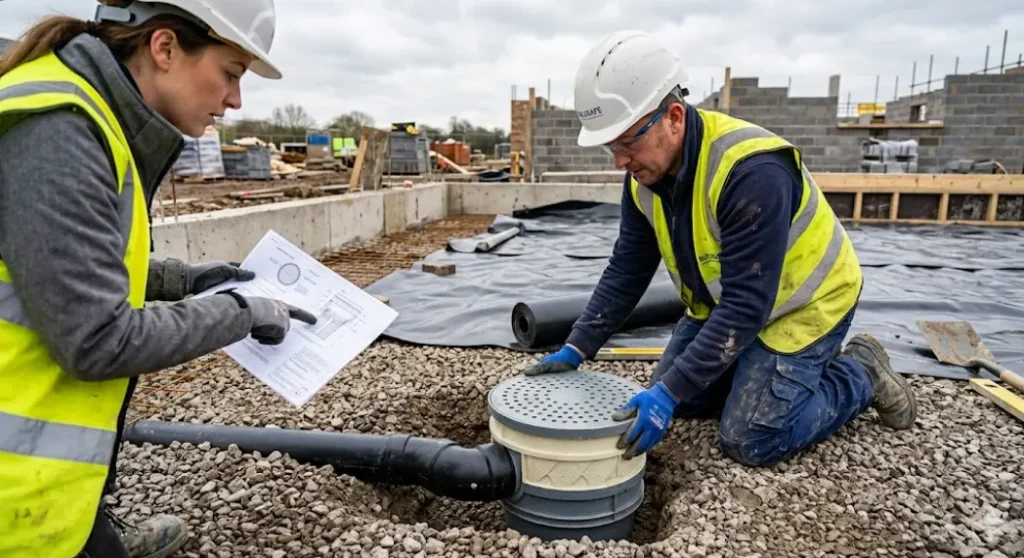
Basic radon protection is a continuous damp-proof membrane modified and extended to form a gas-tight barrier between the building and the ground. The membrane must cover the full footprint of the building and all joints, laps, and service penetrations must be correctly sealed. Full radon protection adds either a sub-floor depressurisation sump, which actively draws radon from beneath the slab and vents it externally, or a fully ventilated sub-floor void that prevents radon accumulation beneath the building.
The Six Developer Obligations in a Radon-Affected Zone
1. Check the current UKHSA radon map for the specific address
Do not rely on the previous map or on a general knowledge of which areas are affected. Check the specific postcode on the interactive map at ukradon.org, or purchase the £3.90 address-level report for the precise risk percentage. This check should be made during the pre-application or design stage, before the gas protection scheme is specified.
2. Incorporate the correct protection level into your design from the outset
The protection level cannot be added retrospectively without significant cost and disruption. BR211 2023 sets out detailed specification requirements for membranes, sump design, ventilation void dimensions, and pipe routing for each protection level. The gas protection designer must produce a site-specific design, not a generic specification lifted from a previous project.
3. Ensure the membrane specification is appropriate for radon, not just ground gas
Not all gas-resistant membranes are equivalent for radon protection. Radon is a significantly smaller molecule than methane and has much greater permeability through materials at the molecular level. The membrane must have a verified low radon diffusion rate. The designer must justify the membrane selection in a design report, as EPG Limited’s Ground Gas Information Sheet No. 5 makes clear: no membrane can claim to comply with BS8485 or with BR211, because both documents are codes of practice, not material specifications. The designer selects and justifies the product.
4. Appoint an independent verifier before installation begins
BR211 2023 specifically improved its references to third-party integrity testing and verification. CIRIA C735 applies to radon protection membrane verification in the same way it applies to ground gas membranes. An independent verifier must produce a Verification Implementation Plan before installation, attend site at each inspection milestone, carry out integrity testing of joints and penetrations, and produce a verification report for submission to the local planning authority or building control officer.
5. Complete the Radon Protective Measures Quality Management Record
New in BR211 2023, Appendix B is the formal quality management record for the protection system. It allocates contractual responsibility to each party, from the designer to the installer to the verifier, at each stage from design through to post-occupancy testing. Completing this record as construction progresses creates a defensible audit trail. The new Appendix B replaced the previous static checklists and is the document that building control officers and local authority environmental health officers will expect to see alongside the verification report.
6. Carry out post-occupancy radon testing where required
In areas requiring full protection, post-occupancy testing at six to twelve months after occupation is recommended by UKHSA. This confirms that the protection system is performing as designed in real-world conditions. Some local planning conditions and mortgage lender requirements in high-radon zones will specifically require a post-occupancy test result before certain obligations are discharged.
How Radon Verification Differs From Ground Gas Verification, and Where They Overlap
Developers who are already familiar with ground gas membrane verification sometimes assume that radon verification is handled separately, through building control rather than planning. On many sites in radon-affected areas, the reality is that the two requirements overlap significantly and must be managed together.
A site classified CS2 for ground gas that also falls within a radon-affected area will typically need a membrane that provides protection against both methane, carbon dioxide, and radon simultaneously. The design must account for both gas types, and the verification must confirm that the installed system meets both sets of requirements. Membranes used for combined ground gas and radon protection must be selected to perform against both gas types, and the design must justify that selection for both.
The verification report produced for planning condition discharge, following CIRIA C735 for ground gas, must also cover the radon protection elements in order to satisfy both building control requirements under BR211 2023 and the planning authority’s environmental health officer. Some local authorities issue combined planning conditions that reference both BS8485 and BR211. A verifier who is competent only in one framework and not the other may produce a report that satisfies one condition but not the other, leading to a second round of submissions.
How We Help Developers in Radon-Affected Zones Stay Compliant
Radon protection in new builds is one of the most frequently mismanaged compliance areas in UK residential development. The updated December 2022 radon map created a new cohort of sites where the protection level has changed without the developer being aware. BR211 2023 introduced a formal quality management record that many design and construction teams have not yet incorporated into their processes. And the requirement for independent verification, which applies equally to radon and ground gas membranes, is still widely misunderstood as a building control matter rather than a verification one.
At Ground Gas Verification, we verify radon protection systems as part of the same independent process we apply to all ground gas membrane installations. We appoint before installation begins, produce the Verification Implementation Plan, attend site at every inspection milestone required under CIRIA C735, carry out integrity testing of joints, laps, sump connections, and service penetrations, and produce a single unified verification report that covers both ground gas and radon protection requirements where both apply to the same site.
Frequently Asked Questions
How do I know if my development site is in a radon-affected area?
Check the UKHSA interactive radon map at ukradon.org. Free 1km grid square data is available. For an address-specific risk percentage, UKHSA offers an individual address check for £3.90. This gives you the precise estimated proportion of properties at that address expected to exceed the 200 Bq/m3 action level, which is what determines the required protection level under BR211 2023.
When was the UK radon map last updated?
The current radon potential map for Great Britain was published by UKHSA and BGS on 1 December 2022, the first update in England and Wales since 2007 and in Scotland since 2011. The Northern Ireland radon map was last updated in 2015 and was not part of the December 2022 update. Any risk assessment based on a pre-December 2022 map should be reconfirmed against the current version.
What is the difference between basic and full radon protection?
Basic protection is a continuous gas-resistant membrane across the full building footprint, with correctly sealed joints and penetrations. Full protection adds either a passive or active radon sump system or a fully ventilated sub-floor void. Basic protection is required where 1% to 10% of properties in an area exceed the 200 Bq/m3 action level in England and Wales. Full protection is required where more than 10% of properties exceed that level.
What is BRE BR211 and is it a legal requirement?
BRE BR211, last updated in May 2023, is the technical guidance document on radon protective measures for new buildings. It is referenced in Approved Document C, which supports the Building Regulations 2010 in England, Wales, and Northern Ireland, and building standards in Scotland. Compliance with Approved Document C is a Building Regulations legal requirement. BR211 is the guidance that tells developers and designers how to achieve that compliance for radon protection.
Does radon protection need independent verification the same way gas membranes do?
Yes. BR211 2023 specifically strengthened its references to third-party integrity testing and verification. CIRIA C735, the governing guidance for gas membrane verification, applies equally to radon protection membranes. An independent verifier must be appointed before installation, must produce a Verification Implementation Plan, attend site at inspection milestones, carry out integrity testing of joints and penetrations, and produce a formal verification report. The verifier must be independent of the installer and any material supplier.
What happens if a radon sump is required but my building control officer has not raised it?
Building control officers are required to check radon protection requirements as part of plan approval. However, the developer and design team are also responsible for ensuring compliance. If your site is in an area requiring full protection and the design does not include a sump, building control should flag this at the plan check stage. If it is missed and the building is occupied without the required protection, the developer may face enforcement action and the homeowner may face significant remediation costs.
Can a single membrane protect against both radon and methane or CO2?
Yes, some membranes are designed and tested to protect against multiple ground gases including radon. However, the designer must specifically justify the membrane selection for each gas type present. Radon requires a membrane with a demonstrably low radon diffusion coefficient, which is not a standard specification for all gas-resistant membranes. Not all ground gas membranes perform equally against radon at the molecular level. The design report must show that the selected product is appropriate for both applications.