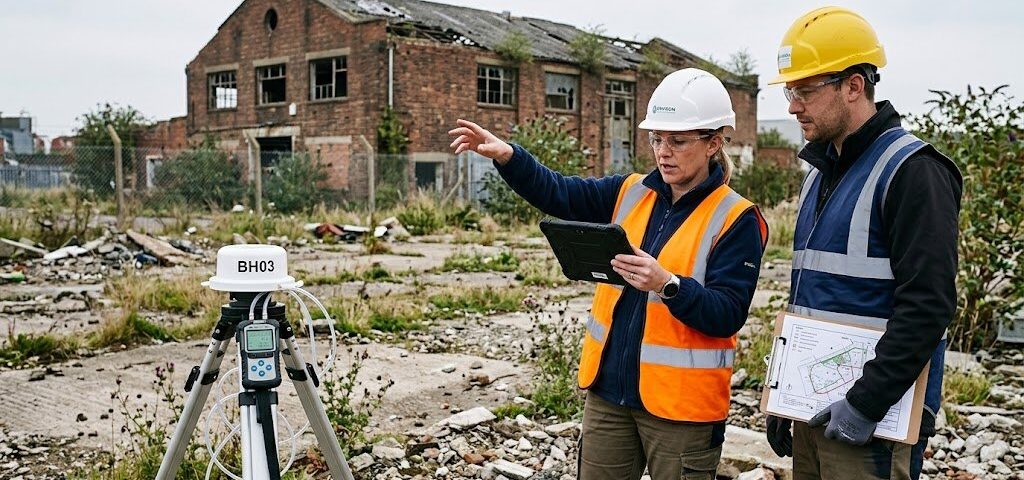
England’s brownfield land can now support at least 1.48 million homes, according to CPRE’s State of Brownfield 2025 report. With the government committing to a brownfield-first approach in the updated National Planning Policy Framework and releasing over £68 million in 2024 alone to unlock brownfield sites, the message to developers is clear: this is where the housing pipeline runs.
But brownfield land comes with a legacy. Former factories, gasworks, landfills, collieries, and industrial estates leave behind more than concrete foundations and buried services. Many carry ground gases that can migrate into buildings, accumulate in confined spaces, and create real danger for future occupants. Understanding what those gases are, how they are assessed, and what developers must do to satisfy planning authorities is not optional. It is the foundation of a viable brownfield scheme.
Why Ground Gas Is a Defining Issue for Brownfield Development in 2026
The UK has over 23,000 recorded historic landfill sites, most of them licensed under the 1974 Control of Pollution Act and many of them long since closed and built over. Organic waste decomposes for decades, generating landfill gas at source in a fixed ratio of roughly 60% methane and 40% carbon dioxide. That gas does not stay where it is produced. It builds up pressure and migrates laterally through permeable soils, sometimes hundreds of metres from its source, and vertically upward into whatever sits above it.
Add to that the legacy of coal mining across the Midlands, Yorkshire, South Wales, and Scotland, the peat and alluvial deposits found across river valleys and low-lying areas, and the volatile organic compounds left behind by decades of industrial activity at fuel depots, chemical works, and dry cleaners, and you have a contamination profile that touches the majority of available brownfield land in England.
For developers, this is not a reason to avoid brownfield. It is a reason to understand it properly. A ground gas risk that is identified, assessed, and managed through an appropriately designed protection system and independently verified installation is a manageable development cost. A ground gas risk that reaches the occupation stage without proper management is a liability that can block building sign-off, void warranties, and create lasting legal exposure.
What Ground Gases Are Found on Brownfield Sites and What Risk Do They Pose?
Not every brownfield site carries every gas. The type and concentration depends entirely on the site’s history and geology. But the following four are the most commonly encountered on UK development sites and the ones most likely to trigger a planning condition.
Methane
Methane is the primary hazard on sites near landfills, former collieries, and areas of organic-rich made ground. It is explosive at concentrations between 5% and 15% by volume in air, and at higher concentrations it is asphyxiating. At source in landfill gas, methane typically makes up around 60% of the gas mixture. Even at low concentrations, methane accumulating in a subfloor void or service void beneath a building creates a serious risk.
Carbon Dioxide
Often overlooked because it is non-flammable, carbon dioxide is the more insidious hazard on many brownfield sites. It is present in landfill gas at source concentrations of around 40%, it is heavier than air and accumulates in below-ground voids and confined spaces, and it is fatal at concentrations above 10% by volume. It can also reach dangerous levels in open excavations on site, posing a risk to construction workers before any building is complete.
Volatile Organic Compounds (VOCs)
VOCs arise from historic contamination by petroleum products, solvents, and industrial chemicals. They are toxic, many are carcinogenic, and they are particularly common on former fuel depot, garage, dry cleaner, and manufacturing sites. VOC vapour intrusion into buildings through inadequate floor construction is a growing concern as mixed-use brownfield sites are brought forward.
Radon
Radon is a naturally occurring radioactive gas produced by the decay of uranium in rock and soil. Elevated radon levels are associated with granite bedrock in Cornwall, Devon, Derbyshire, and parts of Wales and Scotland, but post-2024 updates to the UKHSA radon map have extended the affected zone and made radon a relevant consideration on more development sites than previously.
How Ground Gas Risk Is Assessed on a Brownfield Site
The risk assessment process follows a tiered approach under the UK’s Land Contamination Risk Management (LCRM) guidance and runs through three stages for most brownfield developments.
| Stage | What Happens | Output |
|---|---|---|
| Phase 1 Desk Study | Review of historical maps, Environment Agency records, British Geological Survey data, and any existing site investigation reports to identify potential gas sources within and adjacent to the site | Preliminary risk assessment and recommendation on whether gas monitoring is needed |
| Phase 2 Ground Investigation | Installation of gas monitoring standpipes in boreholes. A minimum of three monitoring visits over several weeks capturing methane, CO2, and oxygen levels under varying atmospheric pressure conditions | Ground Gas Screening Value (GSV) and Characteristic Situation (CS) classification from CS1 to CS4 |
| Gas Protection Design | Design of a gas protection system appropriate to the CS classification, specifying membrane type, ventilation strategy, service penetration details, and points scoring under BS8485:2015+A1:2019 | Gas protection design scheme submitted to local planning authority as a planning condition pre-commencement document |
| What the CS classification actually means for your projectCS1 is low risk and may require only basic protection measures with lighter verification requirements. CS2 is the most common classification on brownfield and former landfill sites, requires a full gas protection membrane and ventilation system, and triggers mandatory independent verification to CIRIA C735. CS3 and CS4 are higher-risk scenarios that require more robust protection systems and more intensive independent verification programmes. |
From Risk Assessment to Gas Protection: What Developers Must Build
Once a site is classified CS2 or above, the planning authority will require a gas protection system to be designed, installed, and independently verified before the building can be occupied. The design is governed by BS8485:2015+A1:2019, the British Standard for gas protection membranes for new buildings, which uses a points-based system to confirm that the combination of protection elements achieves the required level of protection for the site’s CS classification.
A typical CS2 residential development will require a gas-resistant membrane laid across the entire ground floor footprint, with a minimum overlap at joints, sealed service penetrations, and a ventilated sub-floor void or granular layer beneath the slab. Higher CS classifications require additional elements including active ventilation and more complex membrane specifications.
The points available under BS8485 for the gas membrane element can only be claimed if that membrane is independently verified in accordance with CIRIA C735. This is the mechanism that makes independent verification mandatory: without it, the gas barrier does not score the points required for planning compliance. No points, no compliance. No compliance, no planning condition discharge.

The Verification Obligation: Why Brownfield Developers Cannot Skip This Step
CIRIA C735, published in 2014, is the UK guidance document that sets out how gas membrane verification must be carried out. It requires an independent third party to produce a Verification Implementation Plan before installation begins, attend site at multiple inspection milestones during installation, carry out integrity testing where required, and produce a formal Gas Protection Measures Verification Report for submission to the local planning authority.
The verifier must have no commercial connection to the installation contractor or material supplier. This independence requirement is not a suggestion. Section 3.2.2 of CIRIA C735 is explicit, and local planning authorities check it when reviewing submissions. An installer verifying their own work does not satisfy the requirement and submissions based on that approach are regularly rejected.
For developers on brownfield sites, the practical implication is straightforward: the independent verifier should be the first specialist you appoint after your gas protection designer. Before the membrane contractor arrives on site, the Verification Implementation Plan must be written, agreed with the local authority, and ready. Once the slab is poured, the opportunity to carry out a compliant CIRIA C735 verification has passed.
For developers who want to understand the full verification process in detail, Ground Gas Verification provides independent CIRIA C735-compliant verification services across the UK, with no connection to any installer or material supplier.
Frequently Asked Questions
Does every brownfield site have ground gas?
Not every brownfield site has a measurable gas risk, but any site with a history of landfill use, industrial activity, coal mining, or organic-rich made ground should be assessed. The Phase 1 desk study will determine whether gas monitoring is required. Most brownfield sites in England warrant at least a preliminary ground gas assessment.
What is a Characteristic Situation and why does it matter?
A Characteristic Situation (CS) is the risk classification assigned to a site after ground gas monitoring, ranging from CS1 (low risk) to CS4 (very high risk). It determines what level of gas protection system is required and how intensive the independent verification must be. CS2 is the most common classification on brownfield sites and triggers full CIRIA C735 verification.
How long does a ground gas risk assessment take?
A Phase 2 ground gas monitoring programme typically requires a minimum of three monitoring visits spaced over several weeks to capture varying atmospheric pressure conditions. Including the Phase 1 desk study and report preparation, the full assessment process generally takes between 6 and 12 weeks depending on site complexity.
Can I start construction before the gas risk assessment is complete?
No. Pre-commencement planning conditions typically require the gas protection design scheme to be submitted and approved before works begin. Starting construction without discharging pre-commencement conditions can invalidate your planning permission.
What is the difference between a gas protection membrane and independent verification?
The gas protection membrane is the physical barrier installed in the building to prevent gas ingress. Independent verification is the process of inspecting and testing that membrane during installation to confirm it was installed correctly. BS8485 requires both, and the membrane only scores planning compliance points if it has been independently verified to CIRIA C735.
Who carries out independent ground gas verification?
A specialist who is completely independent of the membrane installer and supplier. The recognised accreditation route in the UK is the CL:AIRE Gas Protection Verification Accreditation Scheme (GPVS), which operates two levels: the Technician in Gas Protection Verification (TGPV) for site inspectors, and the Specialist in Gas Protection Verification (SGPV) for those who sign off verification reports.
What happens if ground gas protection is not verified?
The planning condition cannot be discharged and the building cannot legally be occupied. If the issue is discovered after the slab has been poured, local authorities may require opening-up works to inspect the installed membrane, at significant cost and programme delay to the developer.
How Ground Gas Verification Supports Brownfield Developers
Brownfield development is essential to meeting the UK’s housing needs and the commercial opportunity is significant. The sites are there. The planning policy is behind you. But a ground gas risk that is not properly managed from Phase 1 through to verified installation is a genuine threat to programme, budget, and occupancy sign-off.
Ground Gas Verification works with developers, main contractors, and environmental consultants across the UK to deliver the one piece of the process that cannot be self-administered: the independent verification that planning authorities require before a CS2 or above building can be signed off. We produce the Verification Implementation Plan before installation begins, attend site at every required CIRIA C735 inspection milestone, carry out air lance and EHD integrity testing where required, and deliver the Gas Protection Measures Verification Report in the format that planning authorities accept.
We are entirely independent of membrane manufacturers and installation contractors. We work directly for the developer, and our only purpose is to provide an accurate, thorough, and documentable verification that gives your project the compliance evidence it needs to move forward without delay.
If you are developing on brownfield land and want to discuss verification requirements for your specific site, contact us at groundgasverification.co.uk. The earlier we are involved in your project, the more straightforward the path to planning sign-off will be.