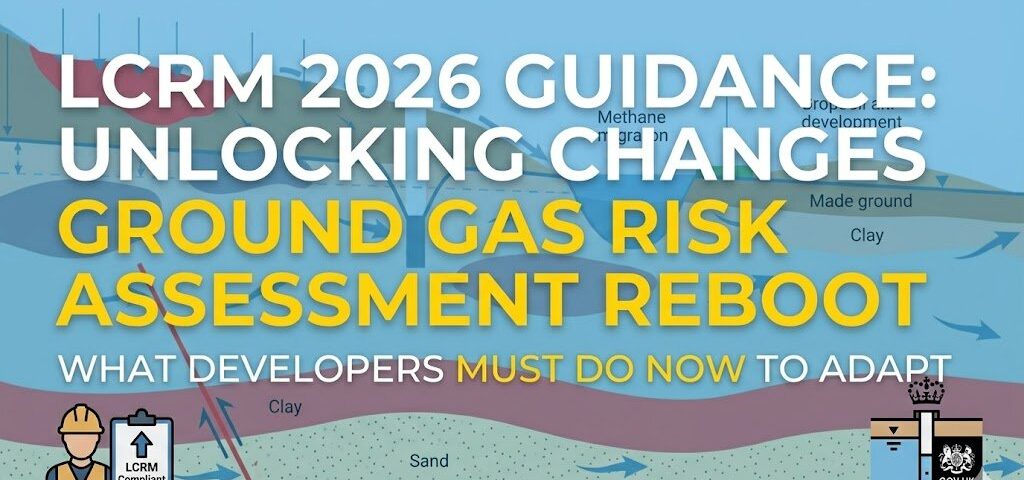
If you are developing on ground that carries a gas risk and your environmental consultant is still referencing CLR11, that document has been withdrawn. The guidance that replaced it, Land Contamination Risk Management (LCRM), has been updated and extended since it was first published in 2020, and the version in effect as you read this, last updated in June 2025 and now widely referred to by industry as LCRM 2025, contains changes that directly affect how ground gas risk assessment is scoped, reported, and verified.
This is not a cosmetic update. Two of the changes are practically significant for developers: the formal integration of the CL:AIRE Gas Protection Verification Accreditation Scheme (GPVS) into the guidance framework, and the strengthened emphasis on conceptual site model quality and data completeness that regulators are now actively enforcing. Understanding both of these, and what local authority officers are currently flagging as the most common reasons for first-time condition rejection, is what this guide is about.
What LCRM Is and Why It Is the Guidance That Governs Your Ground Gas Work
LCRM replaced CLR11, the model procedures for land contamination management that had been the industry framework since 2004. CLR11 was withdrawn in October 2020 when the Environment Agency published LCRM as its successor. Since then, LCRM has been the mandatory procedural framework for managing land contamination risks in England, and the guidance that planning authorities expect developers, consultants, and contractors to follow when dealing with ground gas and other contamination.
LCRM is structured around four HTML guides: Before You Start, Stage 1 Risk Assessment, Stage 2 Options Appraisal, and Stage 3 Remediation and Verification. For ground gas work, Stages 1 and 3 are where almost all developer activity falls. Stage 1 covers the ground gas risk assessment from Phase 1 desk study through gas monitoring and classification. Stage 3 covers the verification of the gas protection system and production of the verification report that discharges the planning condition.
The guidance applies in England, Wales, Scotland, and Northern Ireland, with SEPA, Natural Resources Wales, and the Northern Ireland Environment Agency all having formally adopted it. Any project in any of these jurisdictions that carries a ground gas planning condition is expected to follow LCRM.
What Has Actually Changed: The LCRM Update History That Matters
LCRM is a living document published on GOV.UK. The Environment Agency can update it without a formal consultation process, and it has been updated several times since 2020. The changes that matter most for ground gas developers are as follows.
| Update | What Changed | Impact on Ground Gas Work |
|---|---|---|
| October 2020 | LCRM published, CLR11 withdrawn. Site walkover now required at Preliminary Risk Assessment. UXO assessment must be considered. | Phase 1 desk studies must now include a physical site walkover. Ground gas sources must be considered alongside UXO in preliminary risk. |
| 2021 onward | LCRM extended to Scotland. SEPA produces an information note on its use in Scotland. | Projects in Scotland now follow the same LCRM framework as England for ground gas assessment and verification. |
| 2022 to 2024 | Additional Wales and Northern Ireland references added. Natural Resources Wales formally adopts LCRM. | Ground gas conditions across Wales now expected to follow LCRM framework consistently. |
| June 2025 | New dedicated section added on the CL:AIRE Gas Protection Verification Accreditation Scheme (GPVS). GPVS referenced in the competent person section and throughout LCRM. New protocol for rapid measurement techniques in soil chemical testing added. | GPVS accreditation now formally embedded in national guidance. Competent person definition for ground gas verification updated. Sets industry expectation for who should be doing verification. |
The Change That Matters Most: GPVS Now Formally Embedded in LCRM
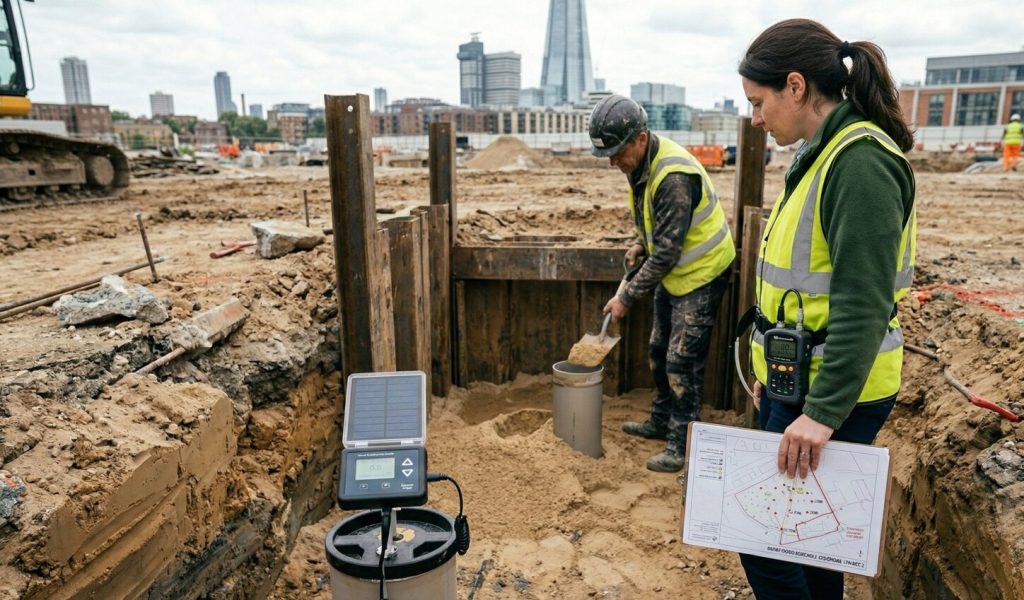
The June 2025 LCRM update that carries the most weight for developers is the formal integration of the CL:AIRE Gas Protection Verification Accreditation Scheme (GPVS) into the national guidance framework. This is not a recommendation tucked into a footnote. The GPVS now has its own named section in the Before You Start guide, it is referenced in the definition of competent person, and it is cited throughout LCRM wherever gas protection verification is discussed.
The Environment Agency has stated explicitly that it supports the GPVS alongside the National Quality Mark Scheme (NQMS), and that the scheme seeks to raise standards in membrane inspection, verification and reporting and provide all stakeholders involved in land contamination management with confidence that risks associated with ground gases have been adequately managed.
What this means in practical terms is that a verifier who holds GPVS accreditation, at either Technician (TGPV) or Specialist (SGPV) level, can now point to their credentials as directly meeting the competent person definition set out in LCRM. A verification report bearing the GPVS Quality Mark from a registered SGPV carries a declaration with a unique reference number traceable on the CL:AIRE register. Planning authority officers who have been told by their legal team to check whether verification work was done by a competent person now have a clear, auditable standard to apply.
| Why the GPVS integration matters for planning condition dischargeLocal planning authorities are increasingly checking not just whether a verification report exists, but whether the person who produced it meets the competent person standard required by LCRM. The GPVS is now the named route within LCRM for demonstrating that competence for ground gas verification specifically. A report from an accredited SGPV is less likely to face competence challenges during planning review than one from an unaccredited individual. |
The Stronger Expectation on Conceptual Site Models and Monitoring Data
Beyond the GPVS integration, the current LCRM framework as interpreted and applied by regulators in 2025 and 2026 places a significantly higher bar on conceptual site model (CSM) quality and monitoring data completeness than was common under CLR11.
A January 2026 article published by the Association of Geotechnical and Geoenvironmental Specialists (AGS), written in the context of LCRM 2025, sets out the expectation clearly: the CSM is now a central requirement of ground gas risk assessment, not an optional supporting document. The CSM must identify the potential sources of ground gas, the pathways by which gas could migrate to buildings or other receptors, and the receptors themselves. Diagrammatic CSMs, showing cross-sections of the site with source, pathway, and receptor relationships mapped visually, are now expected as a matter of course.
On monitoring data, the AGS guidance is equally direct. Full datasets must be captured in AGS format for gas monitoring, not just peak or steady state concentrations and flow rates. Inconsistent data capture is described as a key quality failure that leads to important data being missed from the overall dataset. The expectation is that data from both manual monitoring rounds and continuous monitoring should be provided in full AGS format to enable proper interpretation.
What Local Authority Officers Are Rejecting Most Often Under LCRM
An AGS article published in July 2024, drawing on direct feedback from environmental health practitioners and environmental protection officers who review LCRM submissions for local planning authorities, identified the specific failures that prevent planning conditions from being discharged at the first attempt. These are worth quoting directly because they tell developers exactly what the bar now is.
- Ground gas risk identified at Phase 1 but not pursued during the Phase 2 site investigation, with no justification given.
- No illustrative cross-section CSM showing monitoring findings in the context of the site’s ground gas sources and pathways.
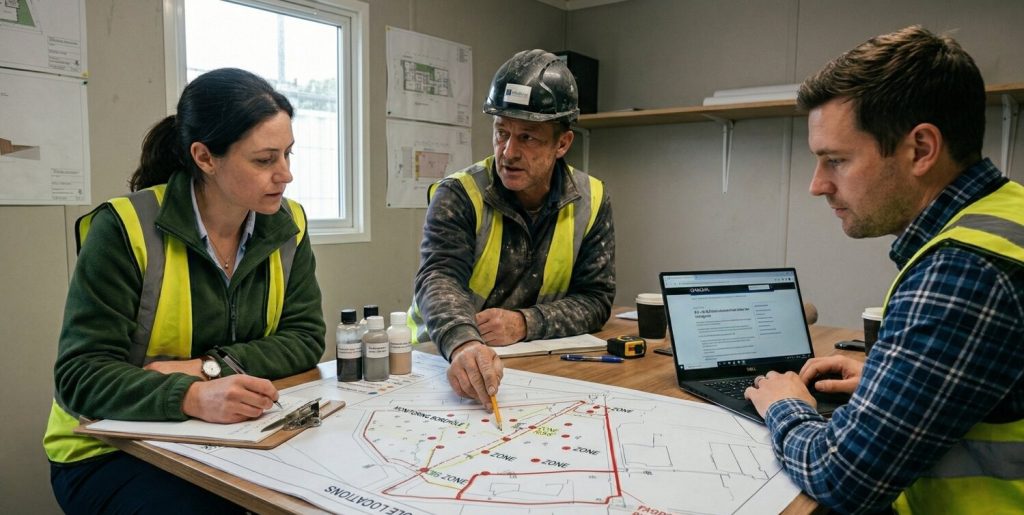
- Sampling and monitoring locations not overlaid on historical site plans or proposed layout plans.
- Larger sites treated as homogeneous rather than being zoned to reflect different land use histories, different geological conditions, or different end uses.
- Risk assessments stopping at Stage 2 GQRA when Stage 3 DQRA would be more appropriate, particularly on more complex or higher-risk sites.
- Verification plans and reports produced by the developer’s groundwork contractor rather than by an independent environmental consultant.
That last point is particularly significant. The regulatory front-line feedback specifically identifies verification work being done by the developer or their groundwork contractor as a quality failure. LCRM, via its integration of CIRIA C735 and the GPVS, is clear that the verifier must be independent and competent. Submissions that come from a contractor self-certifying their own installation are increasingly being challenged.
Four Things Developers Must Do Differently on Ground Gas Projects in 2026
Make sure your Phase 1 includes a site walkover
Under CLR11 a desk study was often sufficient for a Phase 1 preliminary risk assessment. Under LCRM a physical site walkover is mandatory. For ground gas, this means identifying visible signs of gas-generating materials, former landfill indicators, made ground characteristics, and proximity to potential gas sources. If your environmental consultant’s Phase 1 report does not reference a site walkover, it does not comply with LCRM.
Require a diagrammatic CSM at every stage
The conceptual site model should be produced at Phase 1, updated after gas monitoring, and updated again after ground gas protection design. It should show the source-pathway-receptor relationship for ground gas specifically, not just generically for all contaminants. Local authority officers are flagging the absence of a ground-gas-specific CSM cross-section as a consistent reason for requesting additional information before they can discharge a condition.
Insist on full AGS format data from your gas monitoring consultant
When commissioning Phase 2 ground gas monitoring, specify that all monitoring data must be provided in full AGS format, not just peak and steady-state concentrations. The AGS January 2026 guidance is clear that partial data capture is a quality failure. Full datasets, including flow rate data over the full monitoring period, are needed for robust risk assessment and defence of the CS classification if questioned.
Appoint your independent verifier before installation begins
LCRM references CIRIA C735 for verification, and CIRIA C735 requires a Verification Implementation Plan before any membrane is installed. With GPVS now formally embedded in LCRM as the competent person route for verification, there is a clear expectation that the verifier holds accreditation. Appointing an accredited SGPV before installation begins, not after, and having them produce the plan before the membrane contractor arrives on site, is now the standard the guidance expects.
For a full explanation of how the gas membrane verification process works and what CIRIA C735 requires at each stage, visit groundgasverification.co.uk.
Frequently Asked Questions
What is the difference between CLR11 and LCRM?
CLR11 was the Environment Agency’s contaminated land model procedures guidance, first published in 2004 and withdrawn in October 2020. LCRM replaced it as the definitive procedural framework for land contamination risk management. LCRM is shorter, more accessible, and published as four HTML guides on GOV.UK so it can be updated incrementally. The core risk-based approach from CLR11 is preserved but LCRM is the current live standard.
When was LCRM last updated?
The most recent update was published on 12 June 2025. That update added a dedicated section on the CL:AIRE Gas Protection Verification Accreditation Scheme (GPVS) and a new protocol for rapid measurement techniques in soil chemical testing. The industry commonly refers to this current version as LCRM 2025.
Does LCRM apply in Scotland and Wales?
Yes. SEPA formally adopted LCRM for Scotland, and Natural Resources Wales has adopted it for Wales, both now referenced in the guidance itself. Northern Ireland’s NIEA is in the process of adoption. All four UK nations now use LCRM as their primary contaminated land risk management framework, with jurisdiction-specific supplements where needed.
What is the GPVS and why is it now in LCRM?
The Gas Protection Verification Accreditation Scheme (GPVS) was launched by CL:AIRE in January 2021 to raise standards in gas membrane inspection, verification, and reporting. The Environment Agency formally recognised it in the June 2025 LCRM update. GPVS accreditation is now the named route within LCRM for demonstrating competence as a ground gas verifier. There are two levels: TGPV for site inspectors and SGPV for those who sign off verification reports.
What is a conceptual site model and why does LCRM require one for ground gas?
A conceptual site model (CSM) maps the source-pathway-receptor relationships for contamination at a specific site. For ground gas, it identifies the gas-generating sources, the geological and structural pathways through which gas could migrate, and the buildings or people at risk. LCRM requires the CSM to be central to risk assessment, not incidental. A diagrammatic cross-section CSM specific to ground gas is increasingly expected by local authority reviewers before they will accept a risk assessment as complete.
What is full AGS format monitoring data and why does it matter?
AGS is the industry standard digital data format used in the UK for transferring ground investigation data. For gas monitoring, the LCRM-informed expectation, reinforced in the AGS January 2026 guidance, is that full monitoring datasets including all readings, flow rates, and temporal data from both manual and continuous monitoring are provided in AGS format. Submitting only peak concentrations or summary tables is no longer considered good practice and can undermine the robustness of the risk classification.
What This Means for Your Project and How We Can Help
The direction of travel in LCRM is consistent and clear. Each update has moved toward higher data quality standards, greater verifier accountability, and more rigorous planning condition enforcement. The June 2025 update embedding the GPVS into LCRM is the clearest signal yet that the Environment Agency and local planning authorities expect ground gas verification to be carried out by accredited, independent specialists, and that reports which do not meet that bar will face scrutiny.
For developers, this creates a simple decision at the outset of any ground gas project. You can appoint an accredited independent verifier who is familiar with the current LCRM framework, produces CSM-grounded reports, captures full AGS monitoring data, and carries GPVS accreditation. Or you can find out at the planning condition discharge stage that your submission does not meet the standard local authority officers are now being told to apply.
At Ground Gas Verification, we operate within the current LCRM framework on every project. Our verifiers understand what the current guidance requires, what planning officers are checking, and what completeness looks like from the regulator’s perspective. We produce Verification Implementation Plans before installation begins, attend site at every required CIRIA C735 milestone, and deliver verification reports that are structured to discharge planning conditions efficiently.
If you have a ground gas project coming up and want to make sure your verification is LCRM-compliant from the start, contact us at groundgasverification.co.uk. The earlier we are involved, the less likely you are to face delays at the point of condition discharge.