The concrete slab is ready to pour. The membrane is down. The programme is tight. And then the independent verifier attends site and finds something that should not be there.
It happens on more sites than the industry openly admits. CIRIA C735, published in 2014, acknowledged from the outset that there is evidence that the installation of many gas protection systems has failed to meet an acceptable standard. That evidence has not disappeared. What has changed is that independent verification is now mandatory for CS2 and above under BS8485:2015+A1:2019, which means installation failures that once went undetected now result in formal rejection, planning condition disputes, and in the worst cases, opening up works beneath a poured slab.
Every one of the five failures below is preventable. Every one of them is found regularly on UK sites. And every one of them is significantly easier and cheaper to fix before the slab is poured than after.
1. Lap Joints That Are Too Narrow or Poorly Bonded
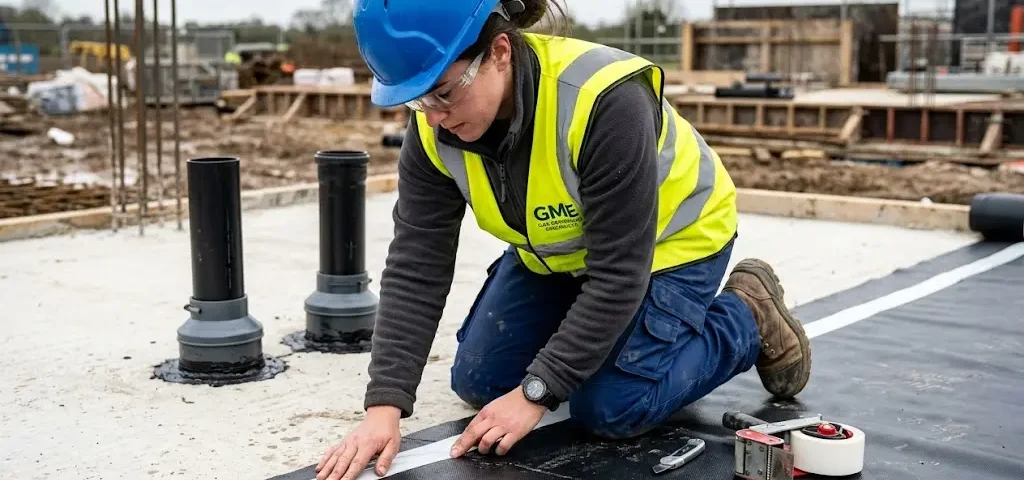
A gas protection membrane is not one continuous sheet. It is laid from rolls that must be overlapped at joints, and those joints must be bonded correctly to form a continuous gas barrier. Get this wrong and gas does not need to find a hole in the membrane. It migrates straight through the joint.
BS8485:2015+A1:2019 and manufacturer installation guidance specify minimum lap widths, typically 100mm to 150mm depending on the product and jointing method. Joints are bonded using proprietary adhesive tape, heat welding, or a combination of both, with different products requiring different methods and different drying or curing conditions. On busy sites where the membrane installer is working quickly to keep ahead of the reinforcement crew, laps get narrowed, adhesive gets applied in cold or damp conditions that prevent proper bonding, and heat welds get rushed at the wrong temperature.
The result is joints that look correct but are not airtight. Air lance testing to ASTM D4437, directed along the joint at a minimum pressure of 345 kPa through a 4.8 mm nozzle at no more than 50 mm from the seam, will find them. The verifier will find them too. And if those joints are already beneath a poured slab, there is no straightforward repair.
| What the verifier finds Laps below minimum width. Adhesive tape applied in damp or cold conditions, lifting at the edges. Heat welds showing cold lines, wrinkles, or separation when pick-tested. Air lance test detecting airflow along the joint. | How to avoid it Brief the installer on minimum lap widths before they arrive. Check ambient temperature and surface moisture before jointing starts. Appoint the verifier before installation so lap requirements are in the Verification Implementation Plan and the installer knows what will be tested. |
2. Service Penetrations That Are Incomplete or Unsealed
Every pipe, duct, and cable that passes through the gas membrane is a potential gas pathway. The membrane must be cut and sealed around each penetration using a proprietary boot, collar, or pre-formed detail that is compatible with the membrane specification and has been tested for the gases present on the site.
In practice, penetration details are the most technically demanding part of a gas membrane installation and the part most often done incorrectly or incompletely. On a typical residential plot, there may be drainage pipes, water supply pipes, electrical conduits, and gas service pipes, each requiring a correctly sized and correctly bonded detail. On more complex commercial or mixed-use developments, the penetration count is significantly higher.
The failures the verifier finds most often at penetrations are membrane cut too close to the pipe with insufficient material to form a proper seal, boot or collar not correctly bonded to the membrane surface, and penetrations where the detail has been installed correctly by the membrane specialist but then disturbed by a plumber or electrician working through the same area afterward. Visual inspection alone will often not reveal the last of these. The RSK Geosciences guidance confirms that air lance testing is the most robust and practical method of identifying such leaks in service entries, and it is carried out along every penetration detail.
| What the verifier finds Boot or collar bonded on one side only. Membrane cut so close to the pipe that no proper seal can be formed. Penetration detail installed correctly then disturbed by follow-on trades. No proprietary detail at all, just membrane folded around the pipe. | How to avoid it Require the installer to photograph every completed penetration detail before the next trade moves in. Include penetration inspection as a specific milestone in the Verification Implementation Plan. Use proprietary pre-formed boots from the membrane manufacturer, not improvised solutions. |
3. Membrane Damage Caused by Follow-On Trades
A gas membrane is installed by specialists, then handed over to a construction site where reinforcement crews, plumbers, electricians, groundworkers, and crane operators all work around and on top of it before the concrete goes in. CIRIA C735 is explicit about this risk: follow-on trades must be made aware of the purpose of gas membranes to reduce the risk of damage.
In reality, this communication does not always happen. The reinforced concrete crew walks boots with stone embedded in the soles across the membrane. A plumber drags a pipe across it. A concrete pump hose gets dragged over it. Steel bar ends are dropped on it. None of this is deliberate. The problem is that the people doing it often do not know what the membrane is or why it matters.
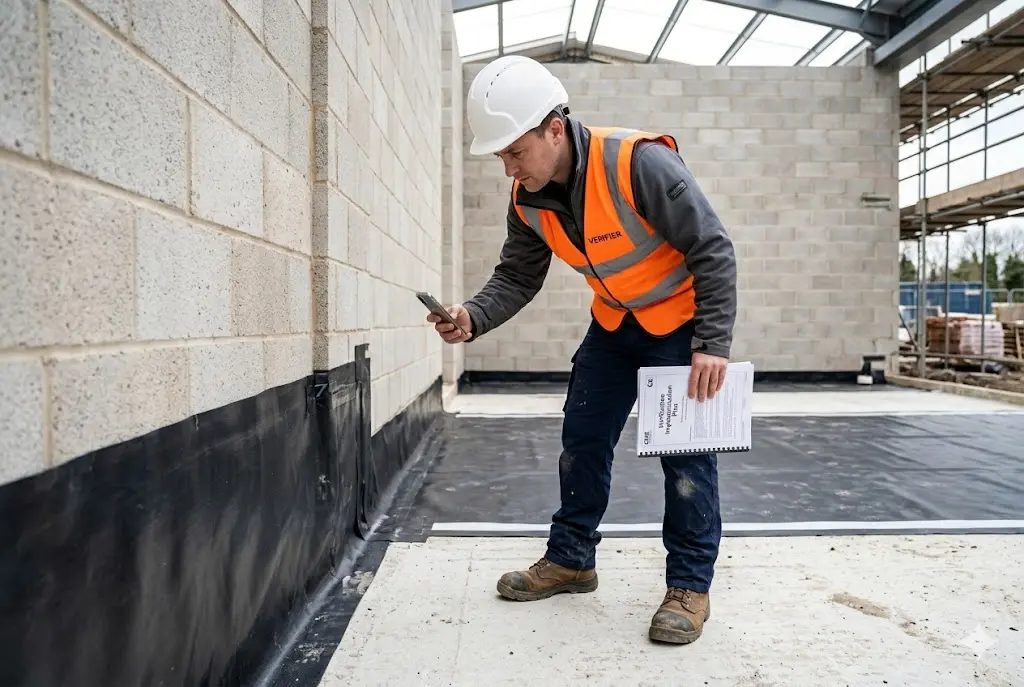
This is why the timing of verifier inspections matters so much. CIRIA C735 requires inspections at key milestones during installation, not just at the end. An inspection carried out after the membrane is laid but before reinforcement starts will find damage caused by the installation crew. An inspection carried out after reinforcement and before pour will catch damage caused by follow-on trades. An inspection carried out after the slab is poured finds nothing, because the membrane is now permanently covered.
| What the verifier finds Punctures from reinforcement bar ends or fixing pins. Tears from dragged equipment or plant access. Displaced sections where membrane has been moved and not repositioned. Sections cut by other trades to route services through. | How to avoid it Include a follow-on trades briefing in the Verification Implementation Plan. Post clear signage on site identifying the membrane and explaining that it must not be damaged. Schedule verifier inspections at each construction milestone, not just pre-pour. Photograph the membrane before each subsequent trade begins work in the same area. |
4. The Wrong Product Was Installed
There is a widespread misunderstanding in the industry about what it means for a gas membrane to comply with BS8485. BS8485 is not a material specification. No membrane can comply with it, because it does not specify a product. It specifies a code of practice. The designer of the gas protection system must select a membrane that is suitable for the specific site, the specific gases, the specific CS classification, and the specific installation method, and they must justify that selection in a gas protection design report.
What this means on site is that the product installed must match the product specified in the approved design. When it does not, the entire points calculation under BS8485 may be invalid, because the points claimed for the gas barrier element depend on the specific product properties of the specified membrane.
Substitutions happen for several reasons. The specified product is out of stock. The installer has a surplus of a different product. A cheaper alternative is sourced without notifying the designer. Sometimes the substitution is genuinely equivalent and can be justified. Often it cannot, and neither the developer nor the designer knows the swap happened until the verifier checks the delivery notes and product data sheet against the approved specification and finds a mismatch.
| What the verifier finds Membrane product on delivery note does not match the approved design specification. Different thickness or permeability rating installed. No BBA certificate or product data sheet available on site for the installed product. Jointing method incompatible with the product actually used. | How to avoid it Require the installer to submit product delivery documentation before the pour. Include the specified product name, manufacturer, and specification in the Verification Implementation Plan. Make clear to the installer that any product substitution must be approved by the designer in writing before installation begins. |
5. No Independent Verifier, or a Verifier Appointed Too Late
This is the one failure that does not show up in integrity testing or product documentation. It shows up when the developer submits their verification report to the local planning authority and the condition comes back rejected, because the verifier was not independent of the installer, or because no Verification Implementation Plan was produced before installation began.
Section 3.2.2 of CIRIA C735 is unambiguous: an independent third party must be used for verification to avoid conflicts of interest. An installer verifying their own work does not satisfy this requirement. A subsidiary company of the installer does not satisfy it. A company with any commercial relationship to the installer or the material supplier does not satisfy it. Local authority contaminated land officers are trained to check these relationships and reject submissions where independence cannot be demonstrated.
The timing issue is equally serious. CIRIA C735 requires the Verification Implementation Plan to be produced before installation begins. This plan sets the inspection milestones, the integrity testing requirements, and the documentation framework for the project. A verifier appointed after the membrane is down cannot have produced it. They cannot confirm what they did not witness. At best, they can produce a partial retrospective assessment. At worst, they cannot produce a compliant verification report at all, and the developer is left with a poured slab, an uncompliant installation, and a planning condition that cannot be discharged.
| What causes rejection No Verification Implementation Plan produced before installation. Verifier is the installing company or commercially connected to them. Verifier appointed after the slab was poured. Report lacks milestone inspection records and photographs. Verifier has no demonstrable competence in gas membrane verification. | How to avoid it Appoint an independent verifier as one of the first appointments on any gas-affected project. Ensure the Verification Implementation Plan is produced and agreed before the membrane contractor arrives on site. Check that your verifier holds GPVS accreditation or equivalent demonstrable qualification. Treat the verifier appointment as a programme item, not an afterthought. |
Getting It Right Before the Slab Goes Down
Every one of these five failures is found on real sites by real verifiers every month. Most of them are straightforward to prevent. A correctly bonded lap takes the same time as a poorly bonded one if the installer knows what is required. A penetration detail done right first time is far less disruptive than one that needs reopening after follow-on trades have been in. A product substitution flagged to the designer before installation begins is a one-email conversation. A damage report from a follow-on trades briefing costs nothing. An independent verifier appointed before installation costs a fraction of what opening-up works cost after.
At Ground Gas Verification, we are appointed before installation begins. We produce the Verification Implementation Plan that tells everyone on site what the requirements are, when we attend, and what we are checking. We carry out air lance testing to ASTM D4437 at every joint, seam, and penetration detail where it is required. We document everything with photographic records at every inspection milestone, and we produce the final Gas Protection Measures Verification Report in the format that local planning authorities accept. We work entirely independently of membrane manufacturers and installation contractors.
If your site has a gas protection membrane going down and you do not yet have a verifier appointed, the time to act is now, before the installer arrives, not after the slab is poured.
Contact Ground Gas Verification at groundgasverification.co.uk to discuss your project and appoint your independent verifier before installation begins.
Frequently Asked Questions
Can I fix a failed gas membrane after the slab has been poured?
In most cases, no. Once the concrete slab has been poured over the membrane, the installed system cannot be accessed or repaired without breaking up the slab. This is why verification must happen during installation, not after. If a verification report is rejected because milestone inspections were not carried out before the pour, local authorities may require opening-up works, which can be extremely costly and programme-damaging.
What happens if the installer substitutes a different membrane product?
If the installed product does not match the approved design specification, the gas barrier element cannot be credited with the points scored under BS8485. The gas protection scheme may no longer achieve the required total score for the site’s Characteristic Situation classification, making it non-compliant. The developer must then either justify the substitution through a design amendment approved by the original designer, or in the most serious cases, remove and replace the membrane.
How often does membrane damage from follow-on trades cause verification failures?
It is one of the most consistently reported failure categories. CIRIA C735 specifically references the risk from follow-on trades as one of the key principles verifiers should focus on, because damage after installation is common on busy construction sites where multiple trades are working in close proximity. Scheduling verifier inspections at each construction milestone, rather than a single pre-pour visit, is the most effective control.
What qualifications should my verifier hold?
Your verifier should hold accreditation through the CL:AIRE Gas Protection Verification Accreditation Scheme (GPVS). The relevant level for signing off verification reports is the Specialist in Gas Protection Verification (SGPV). The GPVS is now formally referenced in the updated LCRM guidance as the recommended route for demonstrating verifier competence, and local planning authorities are increasingly checking for it when reviewing submissions.
If my installer is qualified to NVQ Level 2, does that reduce what the verifier needs to do?
Yes, a qualified installer reduces the required verification intensity. CIRIA C735 states that if unqualified operatives are used, 100% of the installation must be independently inspected, significantly increasing cost and programme time. A qualified installer allows for a milestone-based approach with defined inspection frequencies per Annex 1 of CIRIA C735. However, a qualified installer does not replace the need for an independent verifier at all. The two requirements are separate and both mandatory.